Microscopía de Super-Resolución vía Imágenes de Fluctuación Óptica
Implementa SOFI, técnica computacional de super-resolución que extrae información espacial sub-difracción de fluctuaciones temporales de fluorescencia de quantum dots. Primera implementación SOFI exitosa en Chile. Resuelve características de ~120 nm bajo el límite de difracción de 232 nm.
Contexto de Negocio
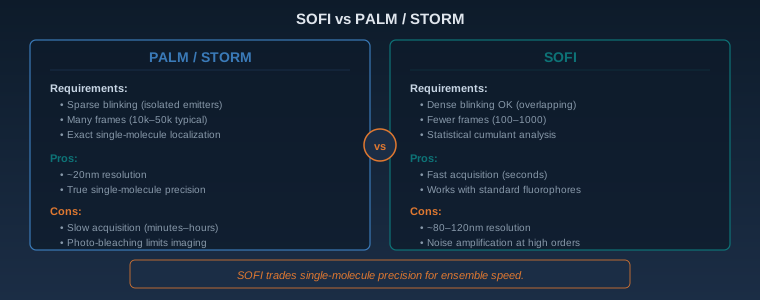
La microscopía óptica convencional no puede resolver características menores a aproximadamente 232 nm (el límite de difracción de Abbe. Técnicas de super-resolución como PALM y STORM rompen esta barrera mediante localización de molécula única, pero requieren dispersión extrema de emisores, sondas fotoconmutables especiales y decenas de miles de cuadros) haciéndolas lentas, costosas e incompatibles con muchos especímenes biológicos e imágenes de células vivas.
Valor Estratégico
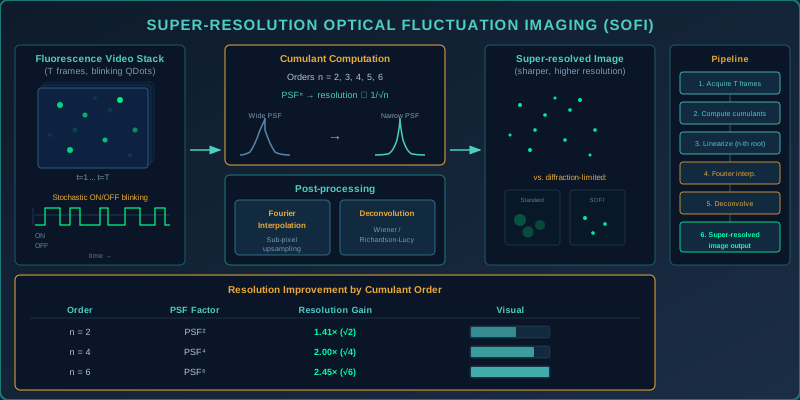
SOFI ofrece un enfoque fundamentalmente diferente a la super-resolución: en lugar de localizar moléculas individuales, explota las estadísticas temporales de emisores que parpadean independientemente para estrechar la función de dispersión de punto efectiva computacionalmente. Funciona con muestras densamente marcadas, hardware estándar de campo amplio, y requiere significativamente menos cuadros (500-1000 vs 10000-50000 para métodos de localización). Esta implementación (la primera SOFI exitosa en Chile, desarrollada en SCIAN-Lab/BNI en colaboración con la Universidad de Göttingen) calcula cumulantes de órdenes 2 a 6, logrando hasta 2.45x de mejora en resolución. La aplicación web modernizada en Python/FastAPI preserva el pipeline computacional completo (cálculo de cumulantes, interpolación de Fourier, deconvolución Wiener y Richardson-Lucy, linealización por raíz enésima) haciéndolo accesible a través de un navegador.
El Desafío
La microscopía óptica está limitada por difracción: d_min = 0.61λ/NA ≈ 232 nm para excitación a 532 nm con objetivo NA 1.4. PALM/STORM requieren condiciones de dispersión de molécula única. SOFI ofrece una alternativa usando estadísticas temporales de emisores parpadeantes.
Nuestro Enfoque
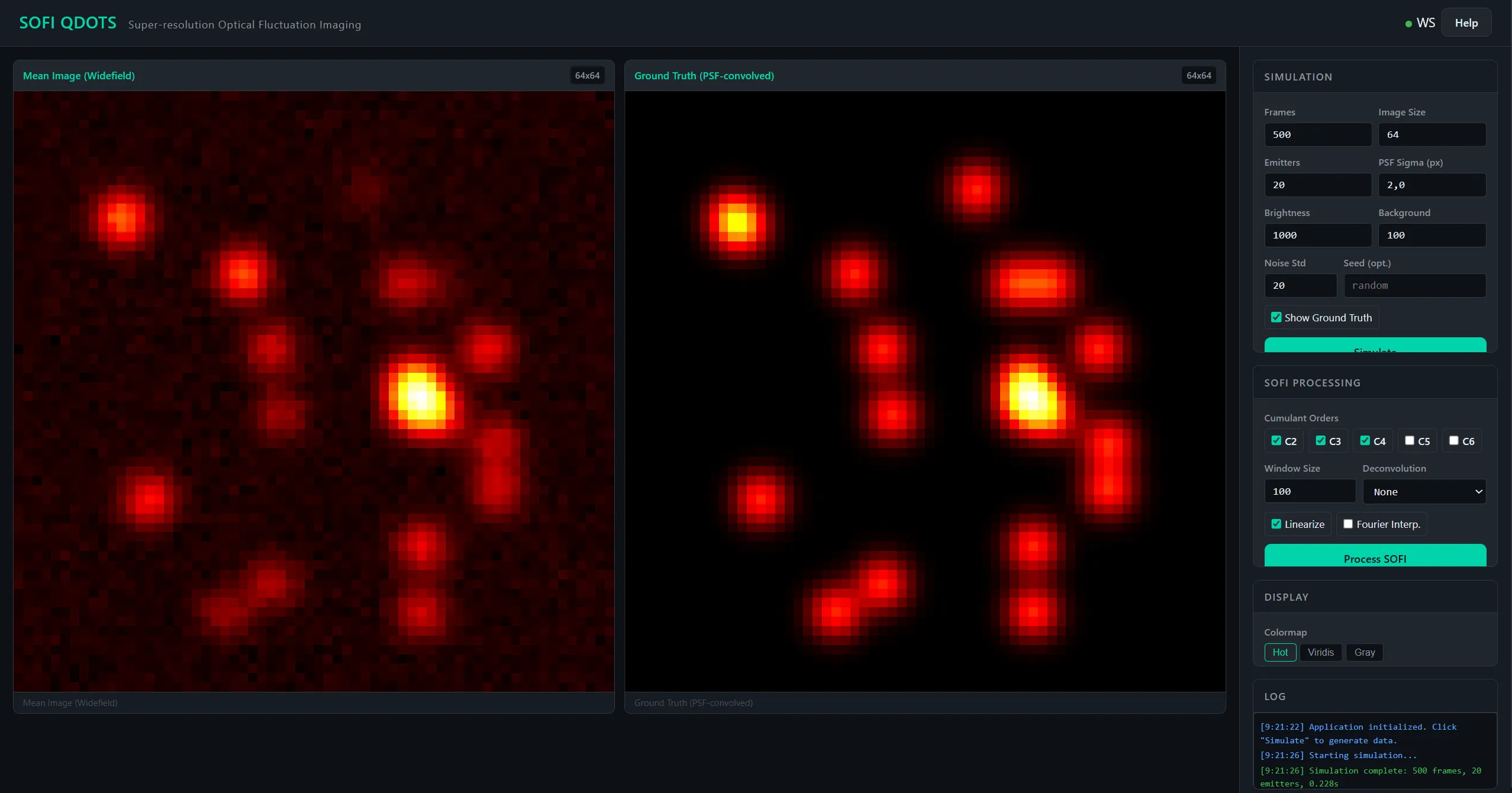
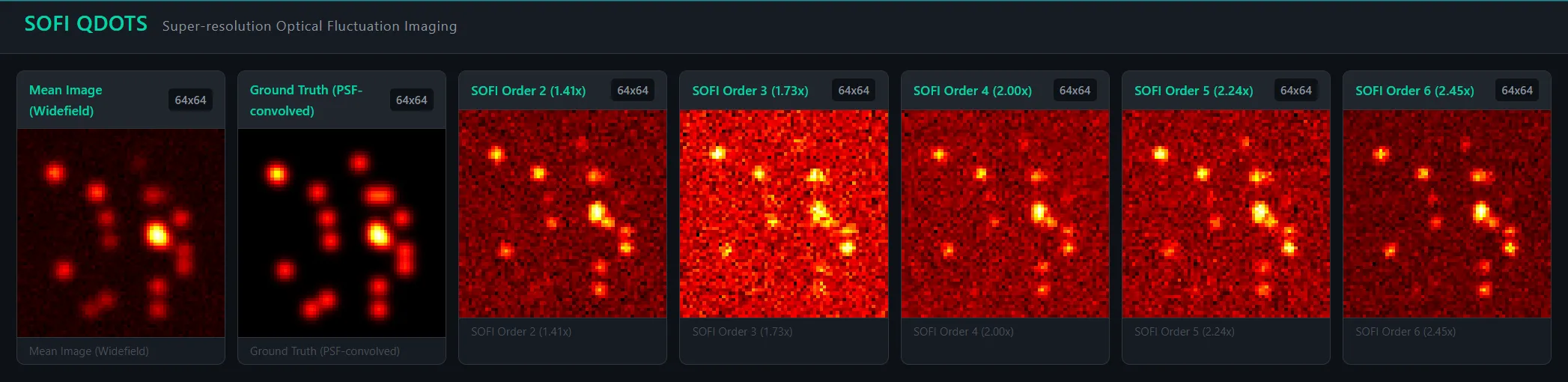
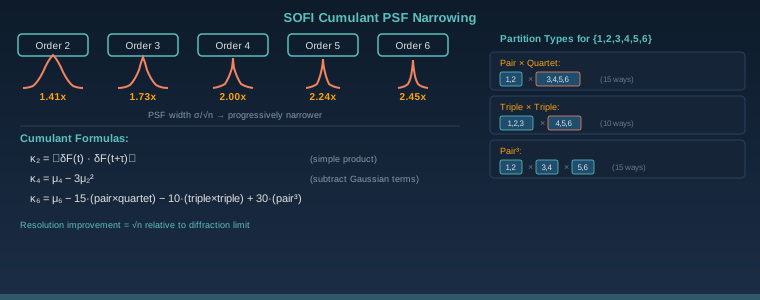
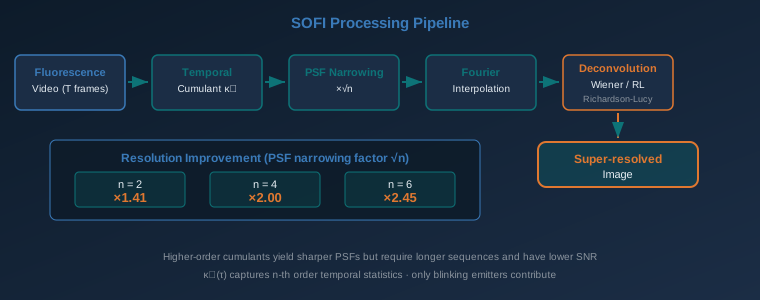
El cálculo del cumulante de orden n estrecha la PSF efectiva en √n. Cumulantes de órdenes 2-6 con retardos temporales consecutivos para eliminar sesgo de ruido shot. Simulador sintético de quantum dots con estadísticas on/off de ley de potencia. Zero-padding en dominio de Fourier para mejora sub-píxel, deconvolución Wiener y Richardson-Lucy, corrección de linealización por raíz enésima.
Indicadores Clave de Rendimiento
| KPI | Línea Base | Resultado | Impacto |
|---|---|---|---|
| Mejora de Resolución | Límite de difracción 232 nm | ~120 nm (6to orden = 2.45x mejora) | Imágenes sub-difracción |
| Significancia Histórica | Sin implementación SOFI en Chile | Primera SOFI exitosa en Chile | Capacidad nacional establecida |
Arquitectura
sofi qdots
Breaking the Diffraction Limit
Conventional optical microscopy cannot resolve features smaller than ~232 nm, the Abbe diffraction limit (d_min = 0.61λ/NA for 532 nm excitation with a 1.4 NA objective). Techniques like PALM and STORM break this barrier through single-molecule localization, but they require extreme emitter sparsity (only a few fluorophores active per frame), special photoswitchable probes, and thousands of frames, making them slow and incompatible with many biological samples.
SOFI offers a fundamentally different approach. Instead of localizing individual molecules, it exploits the temporal statistics of independently blinking emitters to narrow the effective point spread function computationally. It works with densely labeled samples, standard widefield hardware, and requires far fewer frames (~500–1,000 vs ~10,000–50,000 for localization methods).
The Mathematics
The fluorescence intensity at each pixel is a sum of blinking emitter contributions convolved with the microscope’s PSF:
F(r,t) = Σₖ εₖ · sₖ(t) · U(r - rₖ) + noise
The key mathematical insight: the nth-order cumulant of this signal simplifies to:
Cₙ(r) = Σₖ εₖⁿ · κₙ[sₖ] · Uⁿ(r - rₖ)
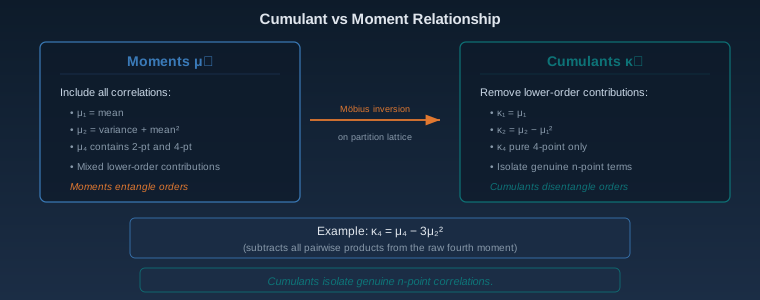
Because cumulants are additive for independent variables, cross-terms between different emitters vanish, a property that moments do not share. The PSF appears raised to the nth power, narrowing the effective width by √n:
| Order | Resolution Gain | Effective Resolution |
|---|---|---|
| 2nd | 1.41x | ~164 nm |
| 4th | 2.00x | ~116 nm |
| 6th | 2.45x | ~95 nm |
The Processing Pipeline
The implementation computes cumulants from orders 2 through 6 using consecutive time lags to eliminate shot noise bias. The 4th-order cumulant requires subtracting three pair-partition products; the 6th-order requires removing 40 partition terms, the combinatorial complexity grows rapidly.
A synthetic quantum dot simulator generates realistic blinking with power-law on/off statistics P(t) ~ t⁻ᵅ (α ≈ 1.5), producing Levy-type statistics where the mean dwell time diverges. This heavy tail means quantum dots can stay dark for very long periods, which is why SOFI needs hundreds of frames for reliable statistics.
Fourier-domain zero-padding provides sub-pixel grid enhancement before cumulant computation. Two deconvolution strategies sharpen the result further: Wiener filtering in the frequency domain with noise regularization, and Richardson-Lucy iterative maximum-likelihood deconvolution preserving non-negativity. An nth-root linearization corrects the εⁿ brightness nonlinearity that would otherwise create extreme contrast ratios between emitters (a 2:1 brightness ratio becomes 64:1 at 6th order).
Historical Significance
This was the first successful SOFI implementation in Chile, developed at SCIAN-Lab (BNI, Universidad de Chile) in collaboration with the III Physics Institute, University of Gottingen, Germany (2012–2014). The original MATLAB codebase was modernized as a Python/FastAPI web application with interactive visualization, WebSocket progress streaming, and 38+ automated tests, preserving the full computational pipeline while making it accessible through a browser.
Stack Tecnológico
Capturas de la Aplicación
Diagramas Técnicos
sofi cumulant orders
sofi cumulant vs moment
sofi pipeline
sofi vs palm