Conectoma, a Fly Connectome Used as a Frozen Vision Network, Measured Against Its Own Nulls
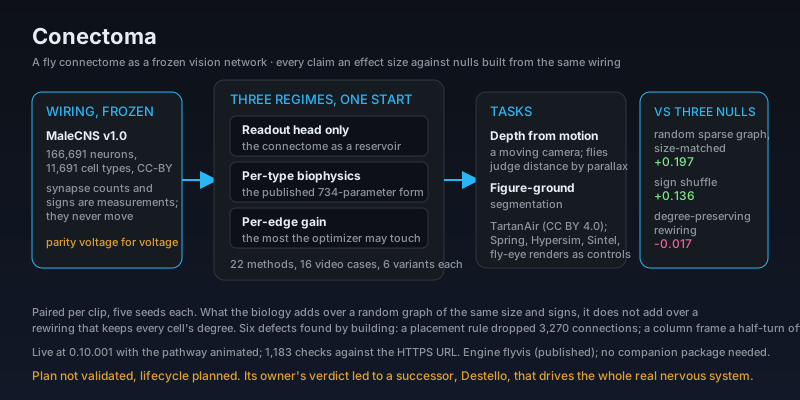
The Janelia MaleCNS v1.0 wiring diagram of the male fruit fly (166,691 neurons, 11,691 cell types, CC-BY) frozen and used as the architecture of a computer-vision network, to measure what a network built from that biology can compute: depth from a moving camera and figure-ground segmentation. Synapse counts and signs never change; three regimes differ only in what the optimizer may touch, and every result is an effect size against null controls built from the same wiring: degree-preserving rewiring, a size-matched random sparse graph, a sign shuffle. With the connectome as a reservoir and a trained readout, paired per clip: +0.197 against the random sparse graph, +0.136 against the sign shuffle, and -0.017 against the degree-preserving rewiring. Live at 0.10.001 with the pathway animated; its plan is not yet validated and the lifecycle reads planned.
Business Context
For a neuroscientist or a computer-vision researcher the product turns a slogan into a falsifiable measurement: with the connectome used as a reservoir and a trained readout, the effect paired per clip on the cases is +0.197 [+0.173, +0.214] against a size-matched random sparse graph, +0.136 [+0.121, +0.168] against a sign shuffle, and -0.017 [-0.021, -0.008] against a degree-preserving rewiring. The third number is the honest one: what the biology adds over a random graph of the same size and the same signs, it does not add over a rewiring that keeps every cell's degree. A negative answer to the central question is a valid, publishable outcome, and the product does not claim that flies perform semantic segmentation or single-image depth estimation, is not a foundation-model competitor, and is not a whole-brain emulation.
Strategic Value
Conectoma is live at its custom domain with the ADR-0071 fit gate run against the HTTPS URL, 1,183 checks passed, every route with and without the trailing slash, and all sixteen case clips verified against their manifests; a certificate that sat unissued for four days with correct DNS was issued in seconds by unsetting and re-setting the custom domain through the Pages API, which is now recorded as the fix. Its plan was proposed and not validated, so the lifecycle reads planned although it is deployed and measured. Its owner's verdict after 0.10 was that it showed a type-level abstraction of one eye rather than the real connectome working, which is why a successor product, Destello, was ordered on 2026-09-23 to drive the whole nervous system through both real compound eyes; Conectoma is left as it is and not reused.
The Challenge
Lappalainen et al. (Nature 2024) constrained a network with the optic-lobe connectome and trained it on optic flow, which is what fly vision evolved for. The open question is whether the same frozen wiring supports dense prediction tasks it did not evolve for in this form, on a newer and larger connectome, and whether any effect can be attributed to the biology rather than to having a large sparse recurrent graph. That second part is where such claims usually fail: without null controls built from the same wiring, "the connectome helps" is a slogan. Flies judge distance from motion parallax, so the cases have to be video, and the connectome tables, the vision datasets and the checkpoints are heavy enough that nothing of them can enter the repository.
Our Approach
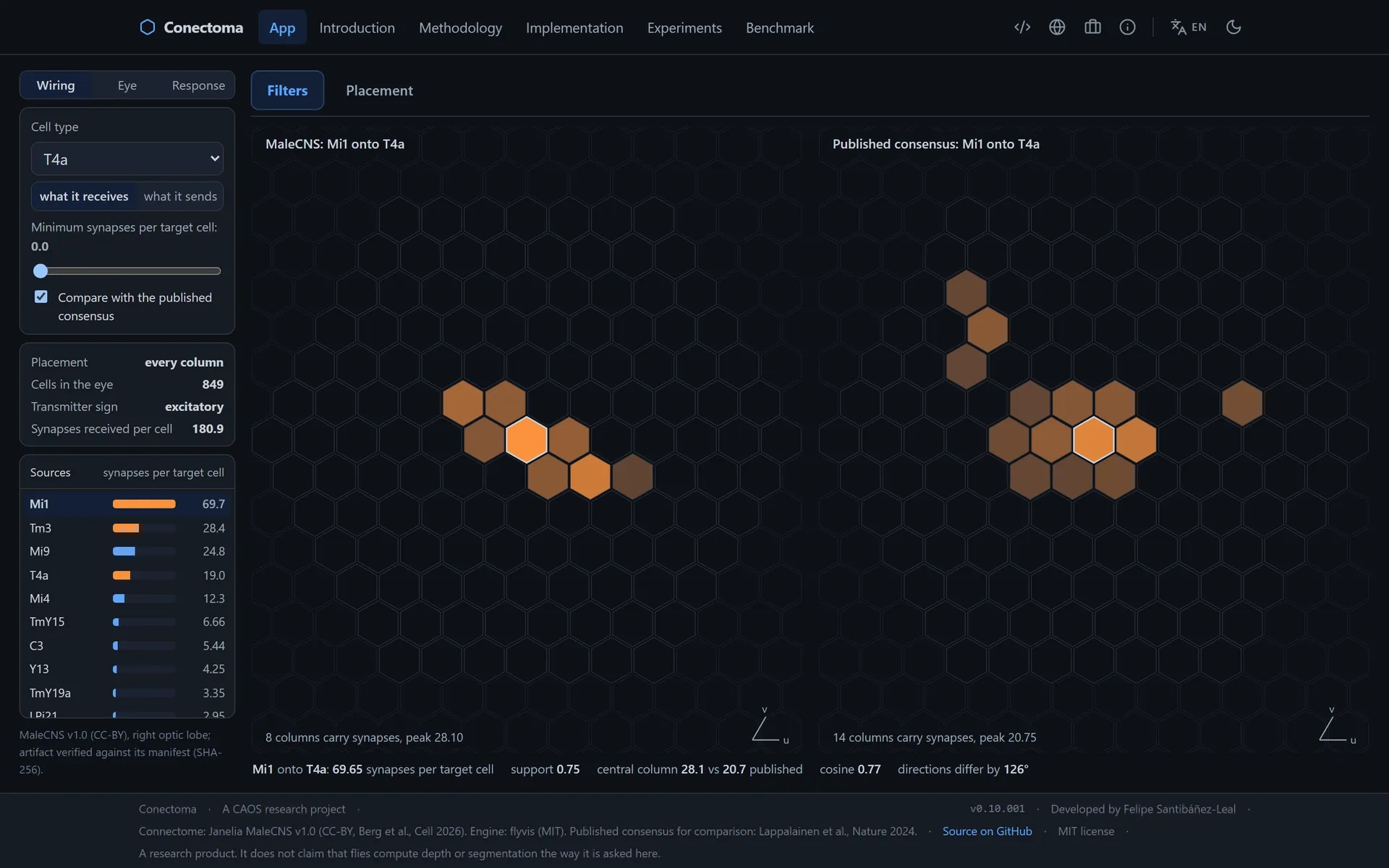
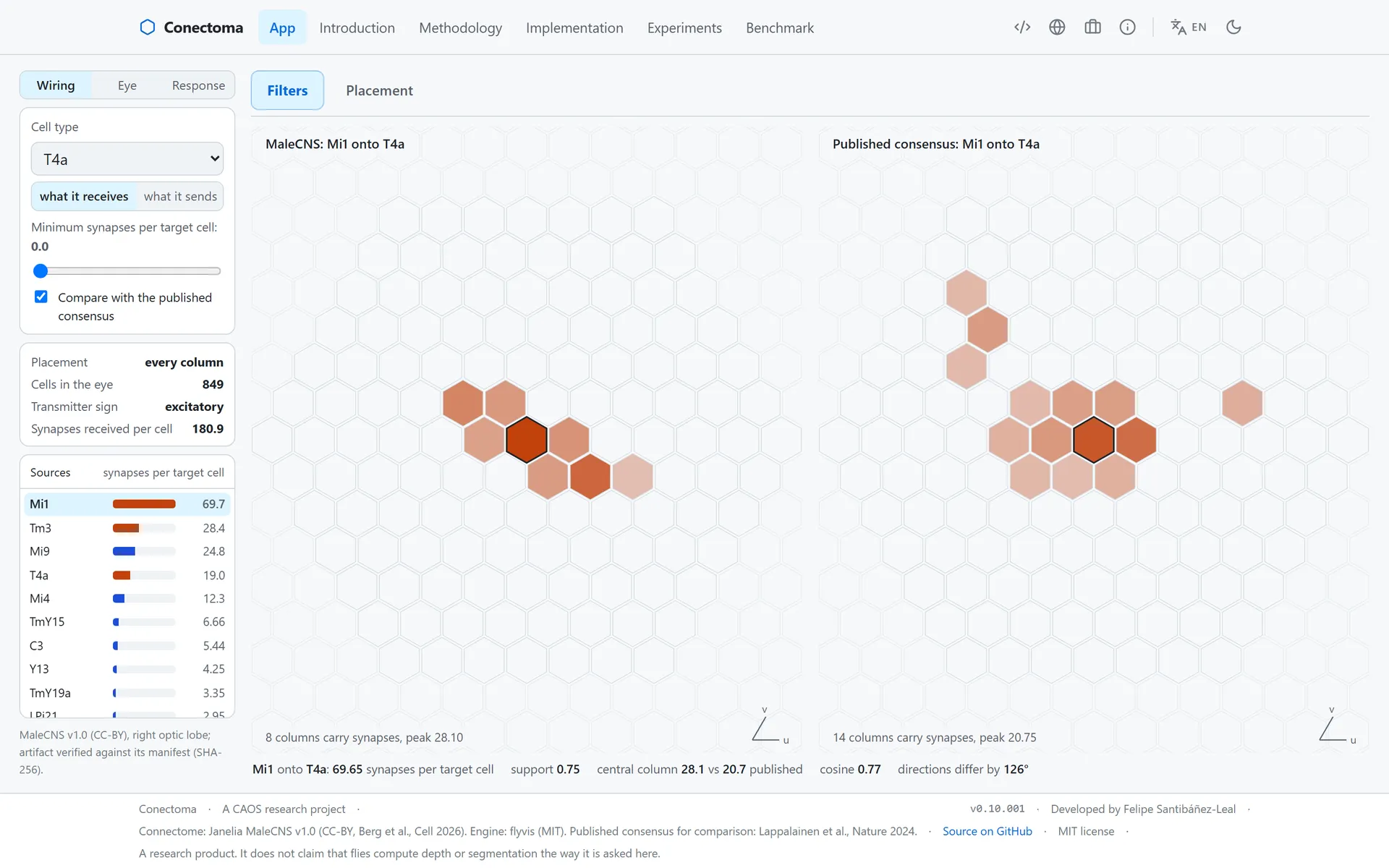
The MaleCNS v1.0 wiring is compiled in memory by a compiler identical to flyvis's on the published connectome and frozen: wiring, synapse counts and signs are measurements and stay fixed. Three regimes share one starting point and differ only in what is learned: a readout head alone, the per-cell-type biophysics in the published 734-parameter form, or a per-edge gain. Null controls are matched in size at the level of cells: degree-preserving rewiring, a size-matched random sparse graph and a sign shuffle. Twenty-two methods plus three controls over sixteen cases with six physical variants each, video-first, with TartanAir (CC BY 4.0) as the vision corpus and Spring, Hypersim, Sintel and locally rendered fly-eye scenes as transfer and control domains. The engine is flyvis, already published, so no companion package was created. Building it exposed and fixed six defects, the largest two inherited from the first unit: the placement rule collapsed tiling populations and dropped 3,270 connections, and the release's column frame was a half-turn off the engine's. The whole visual system runs neuron by neuron (105,011 neurons, 12.45 million connections) as one recurrent component whose loop gain of 3.07 has to be bounded before it is stable. The web replays committed artifacts on the shared shell, with a browser lane behind parity and latency gates; 0.10.001 animates the chain: what the eye receives, what the network concludes, what is really there and where it is wrong, four maps on one clock, with the 90 measured connections among the pathway's 19 cell types pulsing with their drive.
Key Performance Indicators
| KPI | Baseline | Result | Impact |
|---|---|---|---|
| An effect size, against nulls from the same wiring | "The connectome helps", unfalsifiable | Reservoir plus trained readout, paired per clip: +0.197 vs a size-matched random sparse graph, +0.136 vs a sign shuffle, -0.017 vs a degree-preserving rewiring, five seeds each | What the biology adds over a random graph, it does not add over a rewiring that keeps the degrees |
| The wiring is a measurement and never moves | A network "inspired by" a connectome, with everything learnable | Synapse counts and signs frozen; three regimes differ only in what the optimizer may touch (readout, 734 per-type biophysical parameters, per-edge gain); parity with the published model voltage for voltage | Attribution to the biology is testable |
| Defects found by building, recorded | A compiler trusted because it ran | Six defects fixed, two inherited: a placement rule that collapsed tiling populations and dropped 3,270 connections, and a column frame a half-turn off the engine's (T4a would have read as T4b) | The frozen network is stable and trainable at 0.20 s per step |
Architecture
conectoma pipeline
Technology Stack
Application Screenshots