Hyperspectral Mineral Classification Platform
A machine learning platform for classifying minerals and estimating abundances from hyperspectral imagery (VNIR/SWIR). Compresses turnaround from days to minutes for routine mineralogical characterization.
Business Context
In mineral processing, knowing the composition of the ore being fed to the plant is fundamental to optimizing recovery and throughput. Traditional mineral characterization relies on laboratory XRD/XRF analysis, accurate but slow, requiring sample preparation and instrument time that adds days of turnaround per batch. In a mine where ore characteristics change daily, process decisions based on lab results are always based on stale information.
Strategic Value
This platform compresses mineralogical characterization from days to minutes by applying ensemble machine learning (XGBoost, ExtraTrees, CNNs) to hyperspectral imagery captured by VNIR/SWIR cameras. The critical innovation is the compositional constraint layer, predicted mineral abundances must sum to 100% with non-negative values, enforced via quadratic programming. This ensures every pixel's estimate is physically valid and directly usable by geologists without manual correction. Deployed both on conveyor-mounted sensors for in-line monitoring and via drone-based hyperspectral flights for spatial coverage orders of magnitude beyond manual sampling.
The Challenge
Laboratory mineral analysis (XRD/XRF) takes days and requires sample preparation. For geometallurgical applications, faster characterization means tighter feedback loops between ore properties and processing parameters. The key constraint: predicted mineral abundances must sum to 100%.
Our Approach
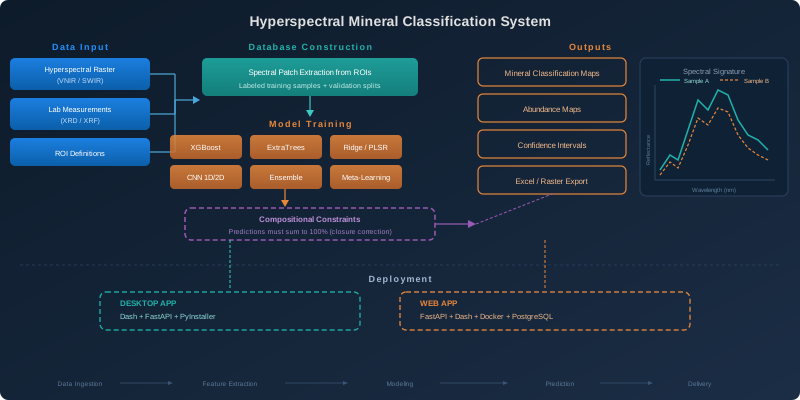
Five-stage pipeline: (1) Data ingestion from VNIR/SWIR cameras with lab references, (2) ROI-aligned spectral patch database with augmentation, (3) Multi-model parallel training: XGBoost, ExtraTrees, Ridge, PLSR, 1D/2D CNNs, (4) Compositional constraints enforcing closure and non-negativity, (5) Mineral maps with per-pixel abundance and confidence intervals.
Key Performance Indicators
| KPI | Baseline | Result | Impact |
|---|---|---|---|
| Characterization Turnaround | Days (lab XRD/XRF) | Hours (conveyor), same-day (drone) | Tight process control feedback |
| Estimation Error | N/A (lab is ground truth) | 3-5% deviation vs lab | Maintains analytical confidence |
| In-line Capability | Not possible | Conveyor-mounted VNIR/SWIR scanning | Real-time ore routing |
Proprietary, source code not publicly available
Architecture
hsi mineral classification
The Laboratory Bottleneck
Traditional mineral characterization relies on laboratory analysis, XRD for crystal structure identification, XRF for elemental composition. These methods are accurate but slow: sample preparation, instrument time, and expert interpretation add up to days of turnaround per batch. In a mine where ore characteristics change daily, this means process decisions are always based on stale information.
This platform closes that gap. It takes hyperspectral imagery, hundreds of narrow spectral bands captured by VNIR/SWIR cameras, and produces mineral classification maps with abundance estimates in minutes, not days. Fast enough for the same shift that extracted the ore.
The Compositional Constraint
The key technical challenge isn’t just classification, it’s the physical requirement that predicted mineral abundances at each pixel must sum to 100%. Geological samples are mixtures: a pixel might be 40% kaolinite, 30% chlorite, 20% muscovite, and 10% quartz. If your model predicts 45% + 35% + 25% + 15% = 120%, the result is geologically meaningless.
The system enforces this through a constrained optimization post-processing step:
min ‖a - a_pred‖² subject to Σaᵢ = 1 and aᵢ ≥ 0
Solved via quadratic programming or simplex projection, this ensures every pixel’s abundance estimate is physically valid without manual correction.
The Pipeline
Data ingestion accepts hyperspectral rasters alongside laboratory reference measurements (XRD/XRF). Regions of interest link spectral patches with ground-truth mineral labels from verified samples.
Multi-model training runs several architectures in parallel: XGBoost, ExtraTrees, Ridge regression, PLSR (Partial Least Squares Regression), and 1D/2D CNNs. Each model captures different aspects of the spectral-mineralogical relationship. An ensemble layer combines predictions through meta-learning.
Output products include mineral classification maps, per-pixel abundance estimates with confidence intervals, and summary statistics. The system handles clays (kaolinite, chlorite, smectite, muscovite), sulfates (alunite), iron oxides (limonite), and phyllosilicates, adapted per mineral system.
Deployment Contexts
The platform has been deployed in two contexts: conveyor-mounted sensors for in-line characterization (hours turnaround, continuous monitoring) and drone-based hyperspectral flights for spatial coverage across exploration sites (same-day results, orders of magnitude more spatial coverage than manual sampling campaigns). Both cases deliver the same fundamental value: mineralogical information fast enough to inform process decisions while the ore is still being processed.
Technology Stack
Visual assets for this project are not publicly available.
This is a proprietary project. Source code and external resources are not publicly available.