Geotechnical Risk Prediction System
A machine learning system for predicting geotechnical hazards, rockburst and slope instability, in underground and open-pit mining. Provides weekly systematic risk assessment with SHAP-based explainability.
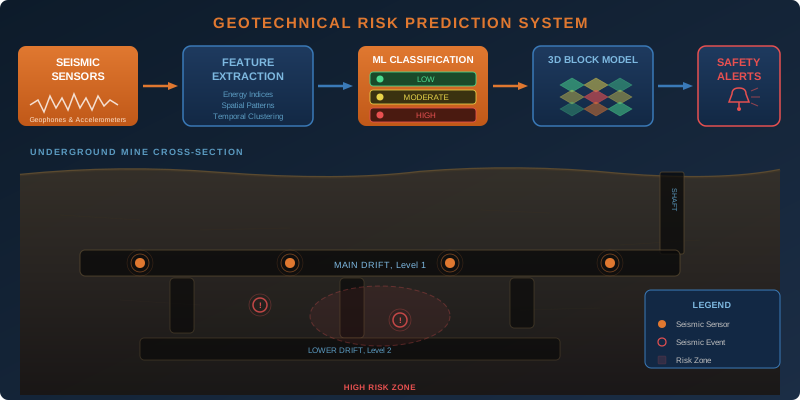
Business Context
Underground mining faces inherent geotechnical risks, rockbursts and slope instability can injure or kill workers and shut down production for weeks. Safety decisions traditionally depend on individual expert judgment applied to seismic monitoring data: an experienced geotechnical engineer reviews thousands of weekly micro-seismic events and applies rule-of-thumb thresholds. The problem is that judgment varies between experts, coverage is inconsistent across shifts, and complex multivariate patterns in the seismic data go undetected by manual analysis.
Strategic Value
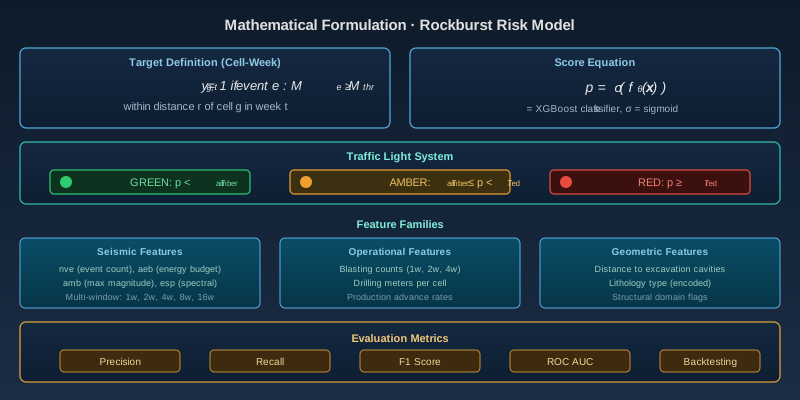
The system provides a consistent, data-driven baseline that augments expert judgment with pattern recognition at scale. XGBoost ensemble models classify spatial blocks into Green/Amber/Red risk levels on a weekly cadence. Feature engineering transforms raw seismic catalogs into four dimensions: energy indices, DBSCAN-based spatial clustering with migration velocity, temporal patterns including seismic quiescence detection and Gutenberg-Richter b-value estimation, and block model integration with geomechanical properties. SHAP explainability was non-negotiable, a black-box risk classification would never be trusted for safety decisions. Each prediction explains why a zone is flagged, enabling geotechnical engineers to validate against their domain knowledge.
The Challenge
Underground mining safety decisions traditionally depend on individual expert judgment, which varies in consistency. Rock mass under stress can fail suddenly. Assessment relies on manual surveys and rule-of-thumb thresholds applied to seismic monitoring data, missing complex multivariate patterns.
Our Approach
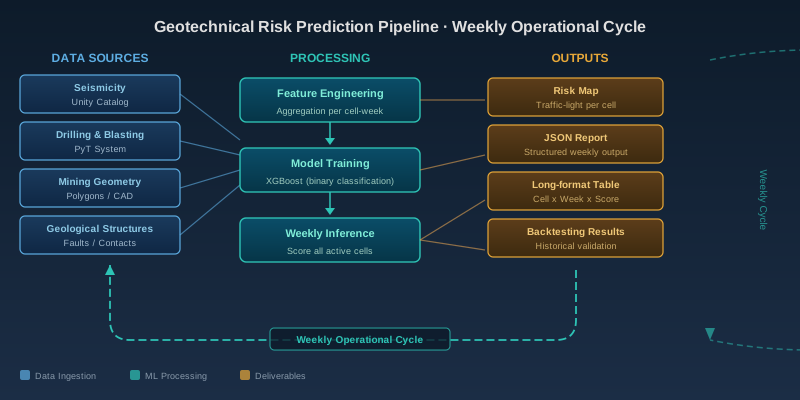
Feature engineering from raw seismic catalogs (energy indices, DBSCAN spatial clustering, migration velocity, Gutenberg-Richter b-values) combined with 3D block model properties. XGBoost ensemble classification into Green/Amber/Red risk levels with SHAP feature importance. Predictions feed operational planning for access restrictions, blasting optimization, and support design.
Key Performance Indicators
| KPI | Baseline | Result | Impact |
|---|---|---|---|
| Detection Capability | Expert-dependent, inconsistent | >80% detection of critical patterns | Systematic, auditable assessment |
| Short-term Support | Post-event response | Pre-event area isolation evaluation | Proactive safety management |
| Assessment Cadence | Irregular, event-triggered | Weekly systematic evaluation | Consistent operational rhythm |
Proprietary, source code not publicly available
Architecture
geotechnical risk
rockburst formulation
rockburst internship scope
rockburst pipeline
Underground Safety
Rock mass under stress can fail suddenly. Rockbursts and slope collapses are among the most dangerous hazards in mining, they can injure or kill workers and shut down production for weeks. The traditional approach relies on individual expert judgment applied to seismic monitoring data: an experienced geotechnical engineer reviews event catalogs and applies rule-of-thumb thresholds. The problem: judgment varies between experts, coverage is inconsistent, and complex multivariate patterns hiding in thousands of weekly micro-seismic events go undetected.
This system provides a consistent, data-driven baseline, not replacing expert judgment, but augmenting it with pattern recognition that humans can’t perform at scale.
From Seismic Events to Risk Predictions
Raw seismic catalogs, thousands of micro-events per week, are transformed into predictive features across four dimensions.
Energy indices track cumulative seismic energy release, apparent stress, and windowed energy rate patterns. Rising energy often precedes failure as strain accumulates in the rock mass.
Spatial features use DBSCAN clustering to identify event concentrations. Migration velocity vectors track how seismic activity moves through the mine. Proximity to mapped geological structures (faults, lithological contacts) adds structural context.
Temporal patterns capture event rate changes over multiple windows. Seismic quiescence, sudden drops in activity, can paradoxically precede large events. Gutenberg-Richter b-value estimation characterizes the frequency-magnitude distribution; declining b-values suggest increasing stress concentration.
Block model integration brings in geological and geomechanical properties from 3D mine models: rock type, UCS, RQD, and stress field estimates.
XGBoost ensemble models classify spatial blocks into Green/Amber/Red risk levels. Each prediction comes with SHAP feature importance, the model explains why a zone is flagged, so geotechnical engineers can validate against their domain knowledge and decide whether to act. This interpretability was non-negotiable: a black-box risk classification would never be trusted for safety decisions.
Predictions feed directly into access restrictions, blasting sequence optimization, and support design recommendations on a weekly cadence.
Technology Stack
Visual assets for this project are not publicly available.
This is a proprietary project. Source code and external resources are not publicly available.