Environmental Monitoring & Mitigation System
An environmental monitoring system combining computer vision, predictive modeling, and Generative AI to detect, forecast, and mitigate pollution events at mining operation sites. Achieved 15% reduction in severe alert events.
Business Context
Environmental compliance in mining is not a nice-to-have, it is a license to operate. Open-pit mining generates airborne particulate matter that affects surrounding communities. Before this system, the environmental response was purely reactive: sparse sensor networks with spatial gaps triggered alerts after pollution events had already peaked. By the time the team responded, the damage window had already opened.
Strategic Value
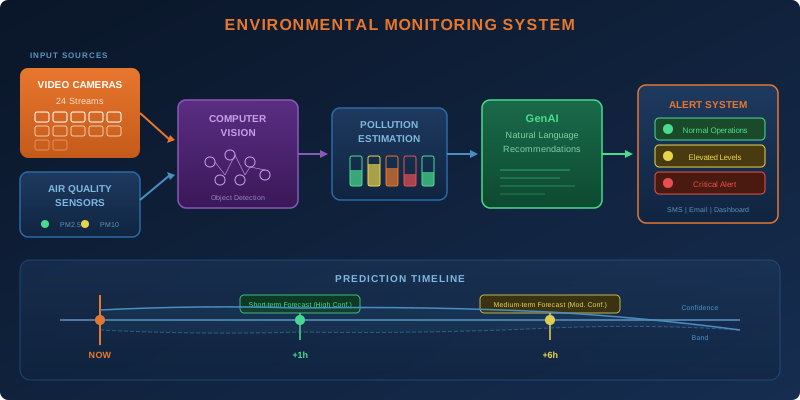
The system reversed the response paradigm entirely, achieving a 15% reduction in severe environmental alert events, not by responding faster, but by anticipating events 1-3 hours before they peak. Twenty-four video camera streams feed deep learning models for dense spatial coverage. Time-series forecasting at 1-hour and 6-hour horizons combines vision estimates with meteorological and operational data. The most impactful design choice was the Generative AI recommendation layer: natural-language guidance written in operator language instead of technical dashboards, maximizing adoption by environmental managers who are domain experts, not data scientists.
The Challenge
Open-pit mining generates airborne particulate matter. Traditional monitoring relies on sparse sensor networks with spatial gaps and delayed reporting. Events can escalate faster than manual response allows. Environmental compliance is a license to operate.
Our Approach
Three integrated stages: (1) Real-time estimation, 24 video camera streams processed with deep learning CNNs calibrated against particulate sensors, (2) Predictive forecasting, time-series models at 1-hour and 6-hour horizons combining pollution, meteorology, and operations data, (3) Intelligent recommendations, GenAI module producing natural-language, actionable guidance in operator language.
Key Performance Indicators
| KPI | Baseline | Result | Impact |
|---|---|---|---|
| Response Paradigm | Reactive: post-peak response | Prescriptive: anticipate 1-3 hours ahead | From damage control to prevention |
| Decision Window | Minutes (after alert) | 1-3 hours (forecast-based) | Planned, cost-effective mitigation |
| Spatial Coverage | Sparse fixed sensors | 24-stream video + sensor fusion | Dense pollution map |
Proprietary, source code not publicly available
Architecture
environmental monitoring
The License to Operate
Environmental compliance in mining isn’t a nice-to-have, it’s a license to operate. Fines, community relations, and regulatory shutdowns make pollution management a business-critical function. Before this system, the response was reactive: a sensor triggers an alert, the team scrambles to respond, but by then the dust plume has already reached the community. The damage window opens before the response even begins.
This system reversed that paradigm entirely. A 15% reduction in severe environmental alert events, not by responding faster, but by anticipating events 1–3 hours before they peak.
How It Works
24 video camera streams feed into deep learning models continuously. CNNs trained on labeled visibility/opacity data perform regression from image patches to particulate concentration estimates, calibrated against co-located physical sensors. The cameras fill the spatial gaps that point sensors can’t cover, a sparse network of fixed instruments becomes a dense pollution map.
Time-series models combine the vision estimates with meteorological data (wind, humidity, temperature), operational schedules (blasting, hauling, loading), and historical patterns to generate forecasts at 1-hour and 6-hour horizons. This gives operators a decision window, enough time for planned mitigation rather than emergency response.
The most impactful design decision was the Generative AI recommendation layer. Rather than presenting dashboards full of charts and metrics, the system produces natural-language guidance written in operator language. Specific, actionable, readable by the environmental manager who knows the operation but isn’t a data scientist. This single choice, language instead of charts, maximized adoption where it mattered most.
Technology Stack
Visual assets for this project are not publicly available.
This is a proprietary project. Source code and external resources are not publicly available.