Inverse Earth Studio, a Geophysical Inversion Workbench on Original Synthetic Earths
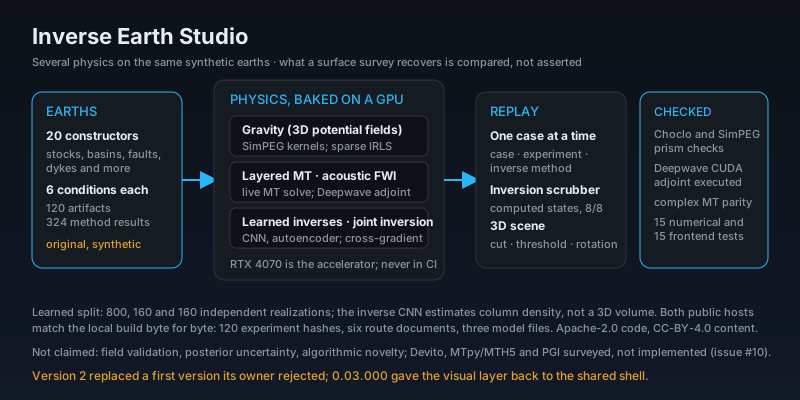
A bilingual geophysics research workbench covering 3D potential fields, layered magnetotellurics, acoustic full-waveform inversion, learned inverses and joint cross-gradient inversion, on twenty distinct geological constructors with six computed conditions each: 120 artifacts and 348 method results, replayed in the browser with an inversion scrubber, a 3D scene with cut, threshold and rotation, and live MT parity. Fifteen numerical tests include an executed Deepwave CUDA adjoint derivative, independent Choclo and SimPEG prism checks, complex MT parity and checkpoint reload; the learned split holds 800, 160 and 160 independent realizations. Original synthetic examples, not field validation; no posterior uncertainty or algorithmic novelty is claimed. Version 2 replaced a first version its owner rejected.
Business Context
For a geoscience student or a reviewer the value is seeing, on the same earth, what gravity alone recovers, what a joint inversion adds and where a learned inverse stops being trustworthy, with the numerical checks that back each method visible on the site. The boundaries are on the page: original synthetic examples, no field validation, no posterior uncertainty and no algorithmic novelty claimed; the inverse network estimates column density, not a volume; Devito, MTpy/MTH5 and PGI were surveyed and are not runtime implementations; the reference course was researched and cited, and none of its notebooks, media or data were redistributed. EDI import, PGI and ensemble uncertainty stay open in a public issue rather than in a roadmap sentence.
Strategic Value
Inverse Earth Studio is the case in the line where a rejected version was withdrawn in full: the whole-project complete claim was retracted, the bespoke palette, fonts and slogan headings were removed in the 0.03.000 correction so the shared shell owns the visual layer, the scientific explanations were rewritten in both languages, and every case was regenerated on refined grids. Both public hosts (the ML VPS and GitHub Pages) were verified byte for byte against the local build: 120 experiment hashes, six route documents and three model files. Engineering verification is stated for what it is; the owner's acceptance of the new design is not inferred, and the plan records the lifecycle as building. On 2026-09-27 a replacement plan and a thirteen-method product design were approved; 0.04.001 stays online as the legacy release while the product is rebuilt.
The Challenge
Geophysical inversion is taught one method at a time on one example each: a gravity anomaly here, a magnetotelluric sounding there, a seismic velocity model somewhere else, each with its own conventions, its own regularization and its own way of hiding non-uniqueness. A workbench that wants to show what a surface survey can and cannot recover has to hold several physics on the same geological cases, run every method on every case under the same conditions, and let the reader watch the inversion converge rather than read that it did. The first version of this product, with a bespoke look and a course's material it had no permission to redistribute, was rejected by its owner; the second is built on original synthetic earths and the shared CAOS shell.
Our Approach
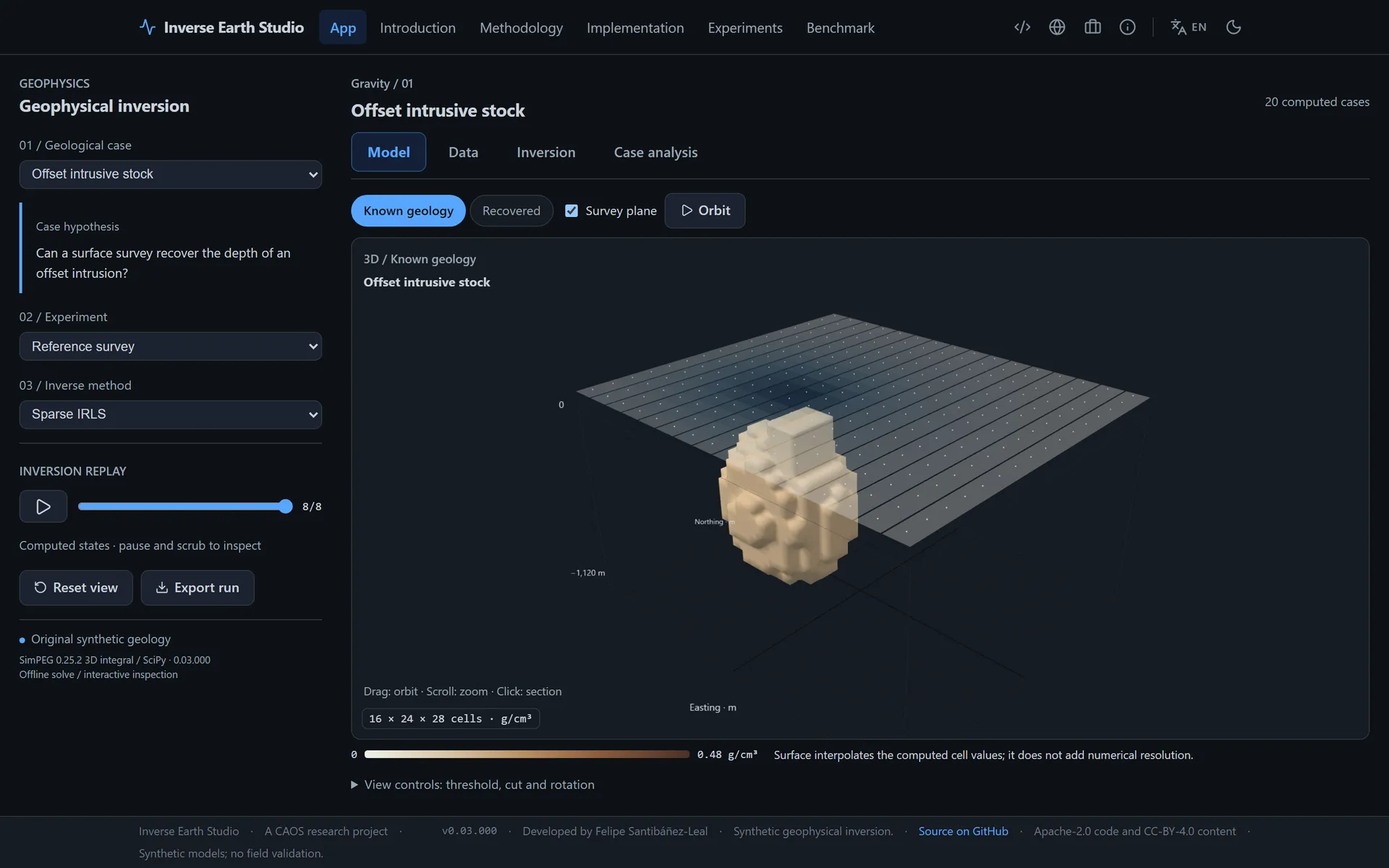
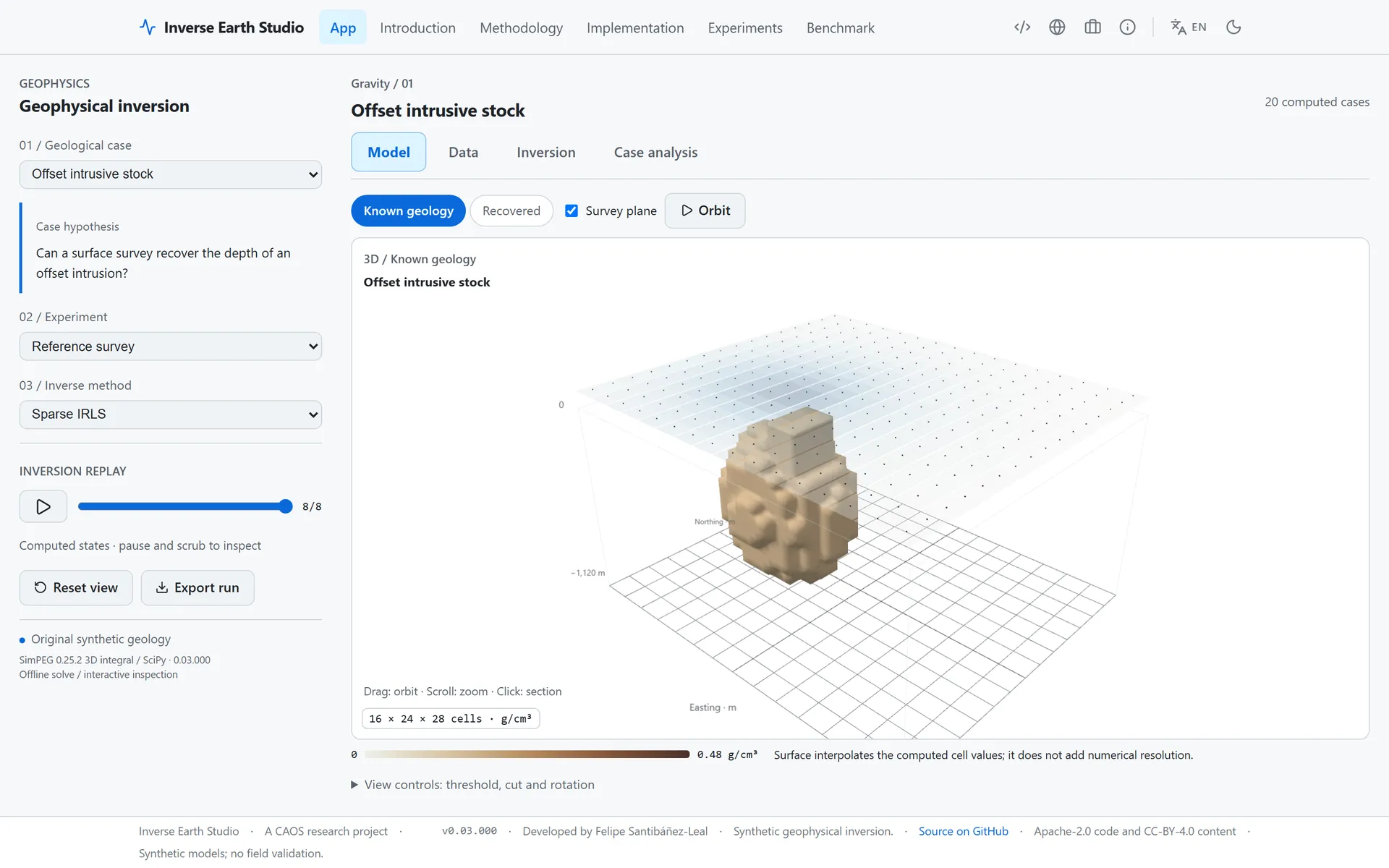
Twenty distinct geological constructors (intrusive stocks, layered basins, faults, dykes and the like) each computed under six conditions produce 120 artifacts and 348 method results, baked locally on an RTX 4070 as the authoritative accelerator and replayed in the browser: the pipeline never runs in CI. The physics: 3D potential fields (gravity) with SimPEG integral kernels checked against independent Choclo and SimPEG prism computations; layered magnetotellurics with complex parity tests and a live browser solve; acoustic full-waveform inversion with an executed Deepwave CUDA adjoint derivative; learned inverses (a CNN and an autoencoder on 800, 160 and 160 independent realizations, the inverse CNN estimating column density rather than a 3D volume); and joint cross-gradient inversion coupling two physics on one earth. The App is one case at a time: a case selector with its hypothesis, the experiment and the inverse method (sparse IRLS among them), an inversion replay scrubber over the computed states, a 3D scene of the known and the recovered geology with survey plane, cut, threshold and rotation, and an export of the run. Six routes on the shared shell, both languages and themes; fifteen frontend tests cover grid orientation, live MT parity, isosurface orientation and bilingual rendering.
Key Performance Indicators
| KPI | Baseline | Result | Impact |
|---|---|---|---|
| Several physics on the same earths | One method, one example, its own conventions | 20 geological constructors under 6 conditions each: 120 artifacts and 348 method results across gravity, layered MT, acoustic FWI, learned inverses and joint cross-gradient inversion | What a survey recovers is compared, not asserted |
| Numerics checked against codes the author does not own | Self-consistency | Independent Choclo and SimPEG prism checks, an executed Deepwave CUDA adjoint derivative, complex MT parity, checkpoint reload and split uniqueness among 15 numerical tests | The replayed numbers are the checked numbers |
| A rejected version, withdrawn | A first version with a bespoke look and material it could not redistribute | Version 2 on original synthetic earths and the shared shell; 0.03.000 removed the custom palette, fonts and slogans and rewrote the science in EN and ES; the complete claim retracted | The record says building, not done |
Architecture
geophysics pipeline
Technology Stack
Application Screenshots