GrainSight, Particle Size Distribution from RGB-D Data
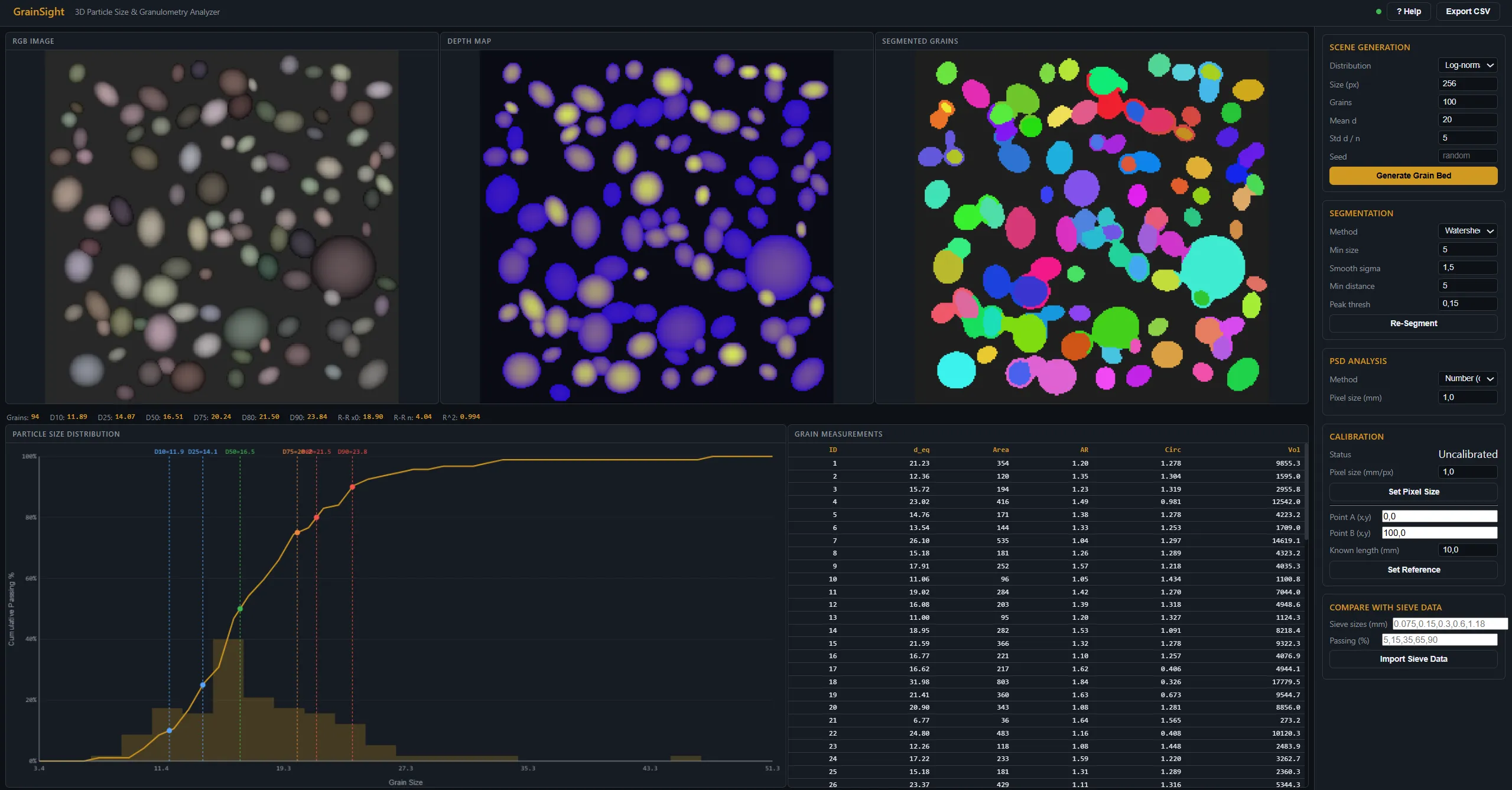
A 3D particle size and granulometry analyzer using marker-based watershed segmentation on RGB-D data. Extracts 18 geometric properties per grain and fits Rosin-Rammler PSD distributions with ISO 565 sieve simulation.
Business Context
Traditional particle size analysis requires physical sieve testing: slow, destructive, and impossible to perform continuously. In mineral processing, grain size distribution directly affects recovery efficiency and product quality. Non-invasive measurement from camera data requires robust segmentation of touching and overlapping particles, where simple thresholding approaches fail completely.
Strategic Value
GrainSight is the third component of a mineral characterization trio (HSI Classification + Depth Profiler + GrainSight) providing non-contact particle size analysis from RGB-D data. Marker-based watershed segmentation identifies individual grains, extracting 18 geometric properties per particle (equivalent diameter, aspect ratio, circularity, volume, and 14 additional descriptors). Rosin-Rammler PSD fitting with ISO 565 sieve simulation provides standardized D-values (D10-D90). Compliant with ISO 13322-1 for image-based particle size measurement.
The Challenge
Traditional particle size analysis requires physical sieve testing: slow, destructive, and impractical for continuous monitoring. Estimating grain size distributions non-invasively from camera data requires robust segmentation of touching and overlapping particles.
Our Approach
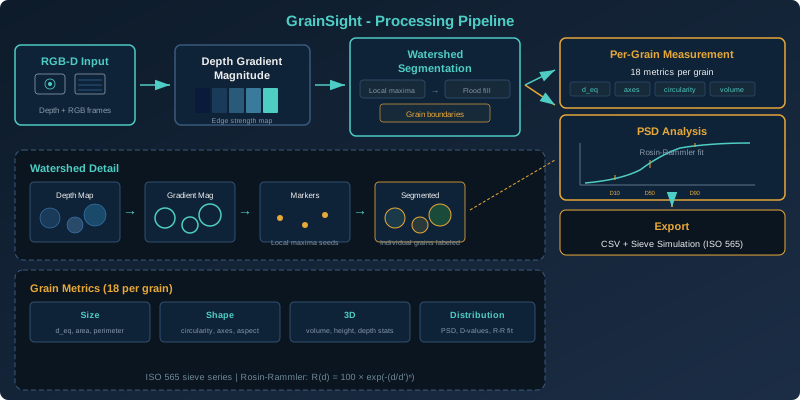
Complete pipeline: RGB-D input, marker-based watershed segmentation for grain identification, extraction of 18 geometric properties per grain (equivalent diameter, aspect ratio, circularity, volume), Rosin-Rammler PSD fitting, D-values extraction (D10, D25, D50), and ISO 565 sieve simulation. Compliant with ISO 13322-1.
Key Performance Indicators
| KPI | Baseline | Result | Impact |
|---|---|---|---|
| Measurement Method | Physical sieve testing | Non-contact RGB-D analysis | Non-destructive, continuous capable |
| Properties per Grain | Sieve fraction only | 18 geometric properties | Rich morphological characterization |
Architecture
grainsize pipeline
grainsize psd
Part of a Trio
GrainSight is the third component of a mineral characterization trio built at ALGES laboratory: HSI Classification identifies the minerals, the Depth Profiler reconstructs the surface in 3D, and GrainSight measures the particles. Together, they provide non-contact characterization from a single RGB-D capture: no sieves, no sample destruction, no laboratory wait time.
The Segmentation Challenge
Traditional particle size analysis means physical sieve testing: slow, destructive, and impossible to do continuously. Estimating grain sizes from camera data requires segmenting individual particles that are touching, overlapping, and partially occluded. Simple thresholding fails completely in these conditions.
Marker-based watershed segmentation solves this: local minima in the depth field serve as grain center seeds, the algorithm floods outward from each seed, and the ridgelines where floods meet define grain boundaries. Post-processing merges over-segmented fragments.
18 Properties Per Grain
Each segmented grain is characterized comprehensively: equivalent diameter d_eq = √(4A/π), aspect ratio AR = d_major/d_minor, circularity C = 4πA/P², volume from depth integration V = Σ(zᵢ - z_base)·Δx·Δy, plus 14 additional shape, texture, and orientation descriptors including convexity, solidity, Feret diameters, and principal axis orientation.
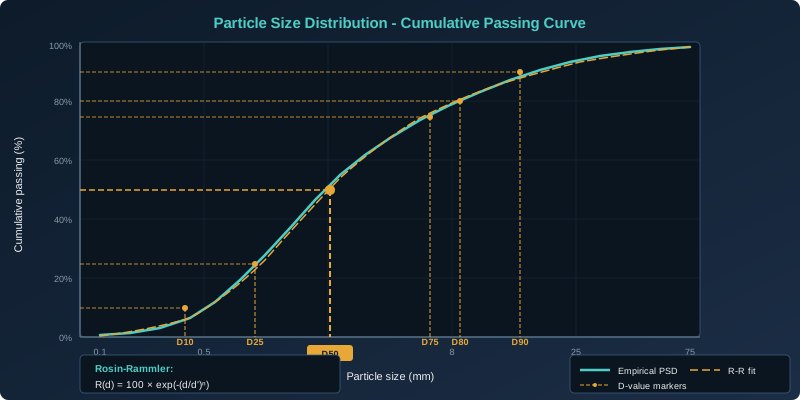
The grain size distribution is fitted to the Rosin-Rammler model, the standard in mineral processing: R(d) = 100 × exp(-(d/d')ⁿ). D-values (D10 through D90) are extracted from the cumulative curve with ISO 565 sieve simulation. The entire analysis is compliant with ISO 13322-1 for image-based particle size measurement.
Technology Stack
Application Screenshots