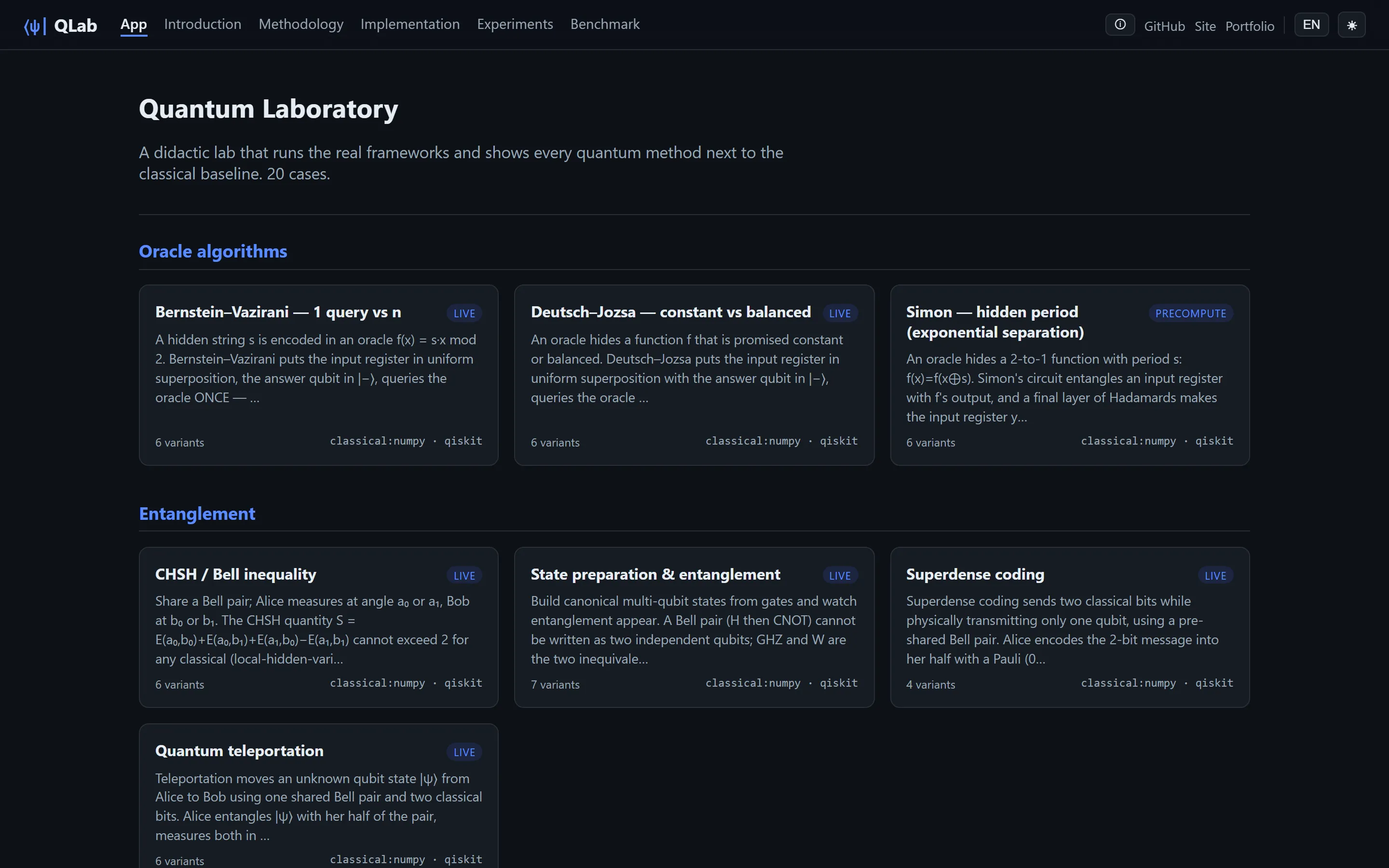
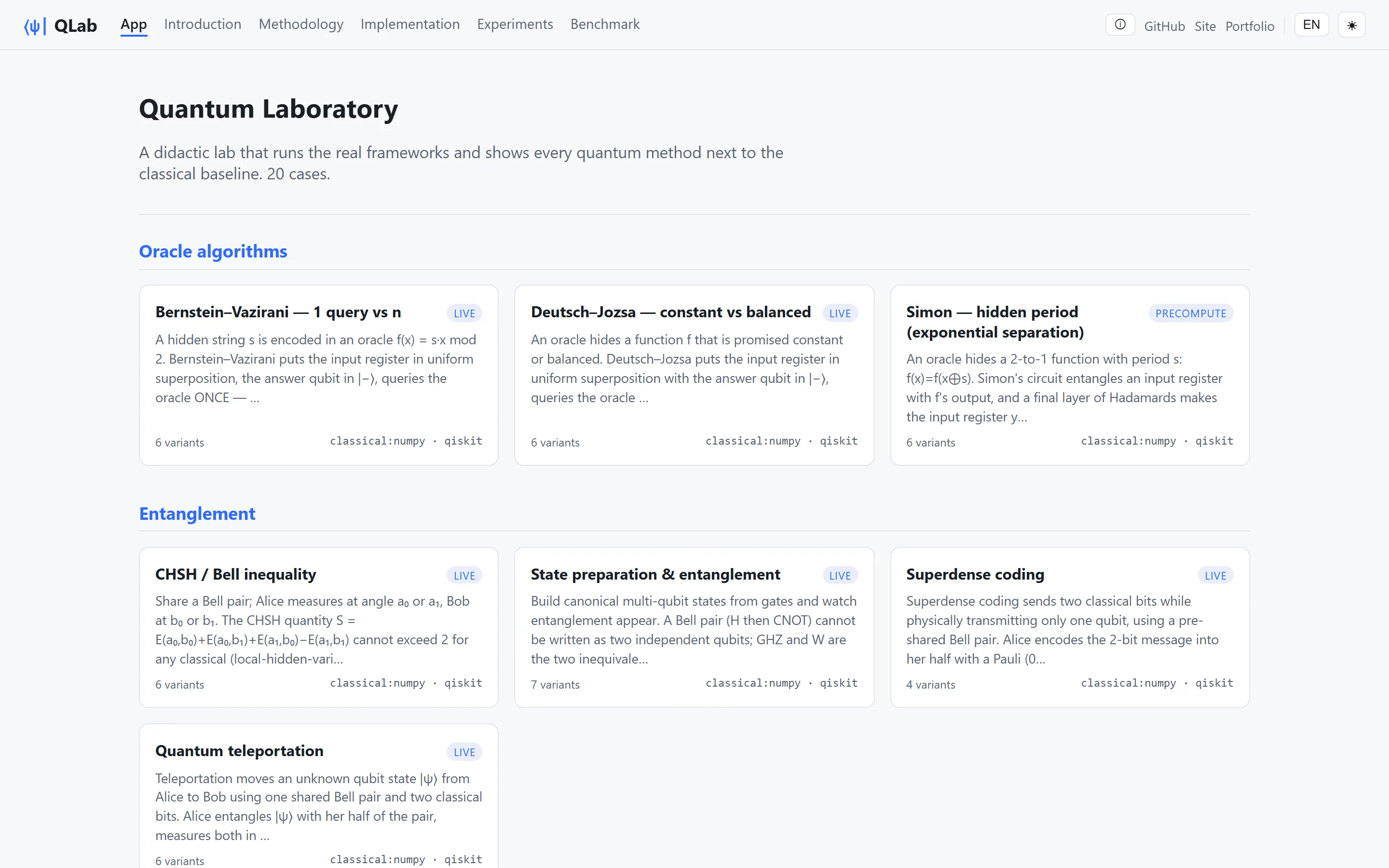
QLab, Quantum Laboratory
A public, didactic quantum-computing lab that runs real frameworks (Qiskit, PennyLane, Cirq, Stim) on 20 worked cases and puts every quantum method next to its classical baseline, and shows that at lab scale, classical still wins.
Business Context
Deciding whether quantum computing matters for a given problem (today, not in a hypothetical future) requires separating genuine quantum effects from speedups that do not yet exist in practice. QLab is a decision and education instrument for exactly that: it makes the field verdict legible by running both sides and putting the costs on screen, so the takeaway is evidence rather than a press release.
Strategic Value
QLab demonstrates fluency across the real quantum toolchain (Qiskit, PennyLane, Cirq, Stim) wrapped in a reproducible, replay-is-truth architecture: and, more rarely, the discipline to report the unflattering result: across 20 cases, zero show a practical pay-for-it speedup. It does flag genuine quantum phenomena (e.g. CHSH violating the classical bound, S = 2√2 > 2) while being explicit that nonlocality is not a speedup. The same static, no-backend, trace-as-data pattern used by the rest of the lab portfolio keeps it cheap to host and fully auditable.
The Challenge
Quantum computing is drowning in marketing. "Quantum advantage" is announced constantly, while a learner has almost no way to run a quantum method, run its classical equivalent, and see, with real numbers, which actually wins and at what cost. Most tutorials stop at one toy circuit on a hand-rolled simulator, and most claims are asserted, not reproducible.
Our Approach
QLab is a Problem × Solver engine: method-agnostic problem formulations and thin solver adapters over the real frameworks (Qiskit + Aer, PennyLane, Cirq, Stim, with scikit-learn / NumPy as the classical foils), each self-registering so adding a framework is one adapter plus one registry line. It ships 20 worked cases across six families (fundamentals, entanglement, oracles, flagship algorithms, variational/QML, noise & QEC) as 119 committed, reproducible JSON traces, every on-screen number is computed by a real engine and replayed, never typed in. The browser runs an exact TypeScript state-vector simulator (≤ 12 qubits) for the live lane, while heavier cases are precomputed offline. Each case shows a quantum-vs-classical comparison panel, qubits, gates, shots, wall-time side by side, with a verdict badge.
Key Performance Indicators
| KPI | Baseline | Result | Impact |
|---|---|---|---|
| Practical quantum speedups demonstrated | Marketed "quantum advantage" | 0 of 20 cases | Teaches the field verdict, with costs on screen |
| Head-to-head worked cases | Tutorial = 1 toy circuit | 20 cases, quantum vs classical | Fundamentals → entanglement → oracles → algorithms → QML → QEC |
| Reproducibility | Numbers typed into slides | 119 committed traces, run = f(params, seed) | Every number regenerable, replay is truth |
Architecture
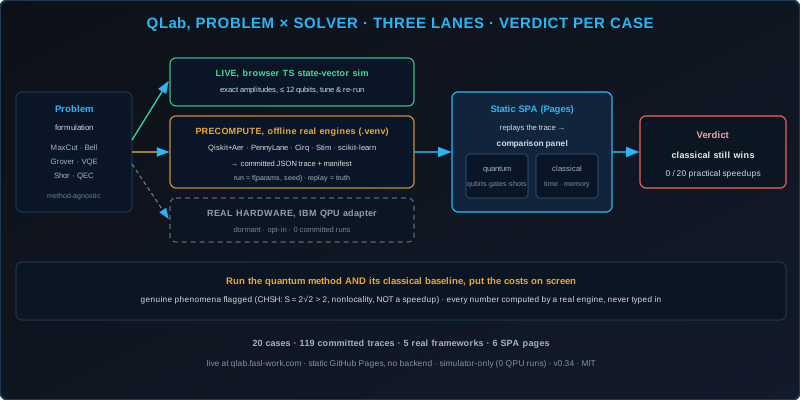
qlab architecture
Run both sides, show the costs
QLab is an open, didactic quantum-computing lab. It runs the real frameworks (Qiskit + Aer, PennyLane, Cirq, Stim) on 20 worked cases, and for each one it puts the quantum method next to its classical baseline so you can see, with real numbers, which wins and at what cost. Live at qlab.fasl-work.com.
The thesis
Across all 20 cases, none shows a practical, pay-for-it quantum speedup: at lab scale, classical still wins, and QLab shows the qubits / gates / shots / wall-time side by side so the verdict is evidence, not a slogan. It is careful about the difference between a genuine quantum phenomenon and a quantum advantage: the CHSH case really does violate the classical bound (S = 2√2 > 2), and QLab labels that as nonlocality, not a speedup.
Architecture, Problem × Solver, replay is truth
A method-agnostic problem formulation meets a thin solver adapter; adapters self-register, so adding a framework is one adapter plus one registry line. A run is a pure function of (params, seed) → a committed JSON trace (119 of them, with manifests). The front end only replays traces, or runs an exact TypeScript state-vector simulator (≤ 12 qubits) for the live in-browser lane; heavier cases are precomputed offline by the real Python engines. No backend, no secrets, static GitHub Pages.
What it is not
QLab runs on simulators: every committed trace is ran_on: simulator. The IBM-Quantum adapter exists but is dormant and opt-in, with zero committed QPU runs, so QLab makes no real-hardware or quantum-advantage claims. Qiskit runs offline only (the browser lane is the custom TS simulator, since Qiskit has no browser build). The flagship algorithms are at educational scale (Shor N = 15, VQE on H₂, small QEC codes).
Technology Stack
In action
A short tour of the live app: the real interface, recorded from the deployed site.
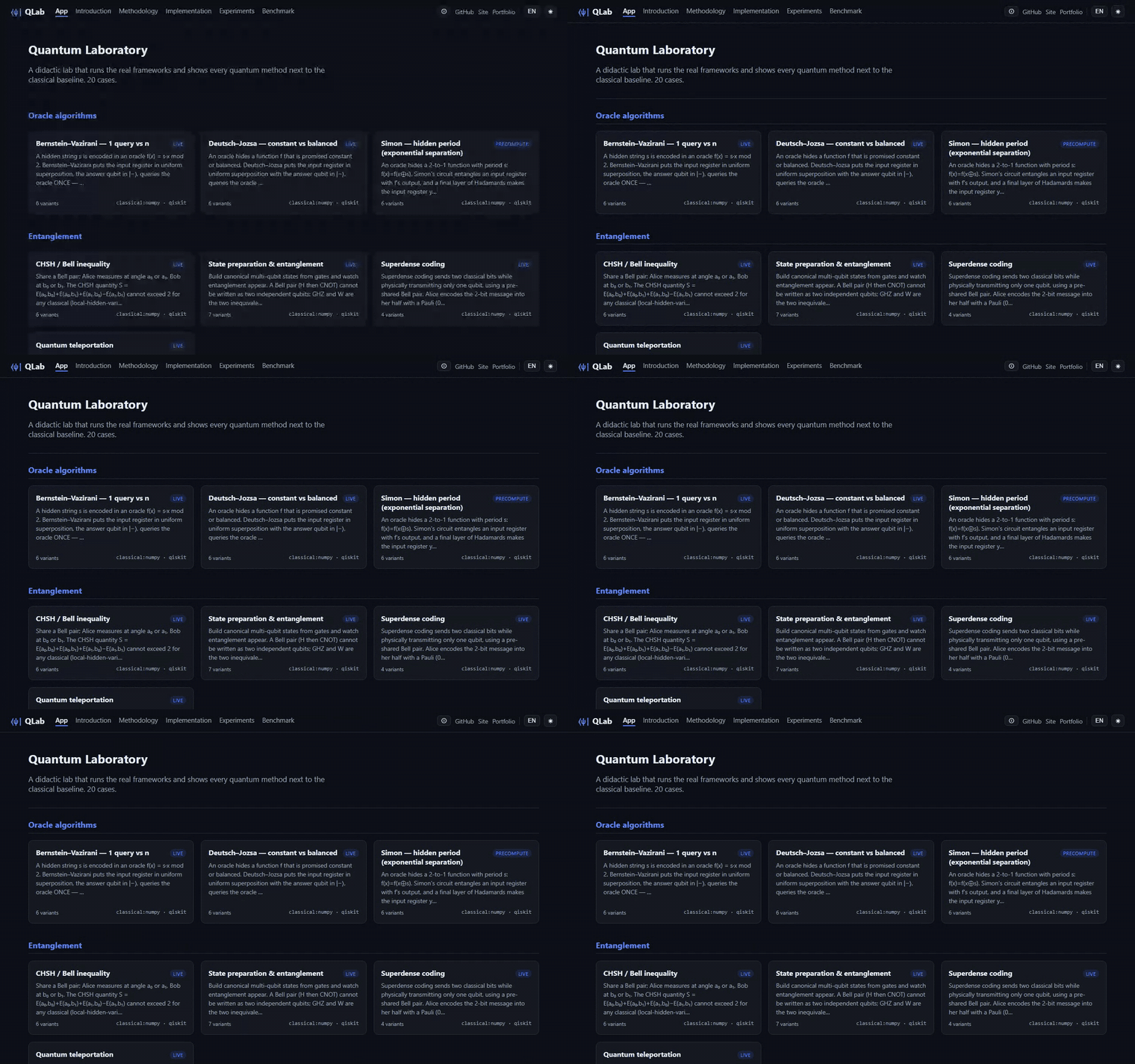
Application Screenshots