QMine, Quantum Computing Measured on Real Mining Problems
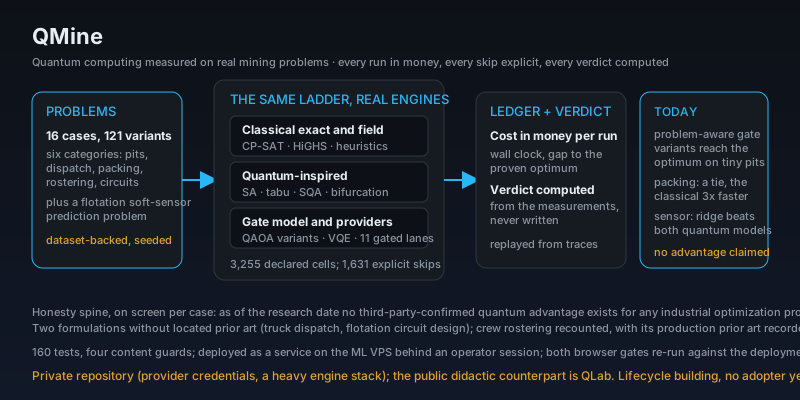
A private research app that measures what today's quantum providers can actually do on real, data-driven mining problems. Every case runs the same ladder end to end: proven-optimal classical solvers, the field heuristics a plant uses, the strongest quantum-inspired algorithms, the gate-model method family on simulators, and the real provider lanes when their credentials exist, with a money-denominated cost ledger and a computed verdict on every instance. Sixteen cases, 121 variants and 3,255 declared solver cells across six categories plus a flotation soft-sensor prediction problem, baked completely with every skip explicit. The honesty spine, on screen per case: as of the research date there is no third-party-confirmed quantum advantage for any industrial optimization problem, and today the classical baseline usually wins. Lifecycle: building.
Business Context
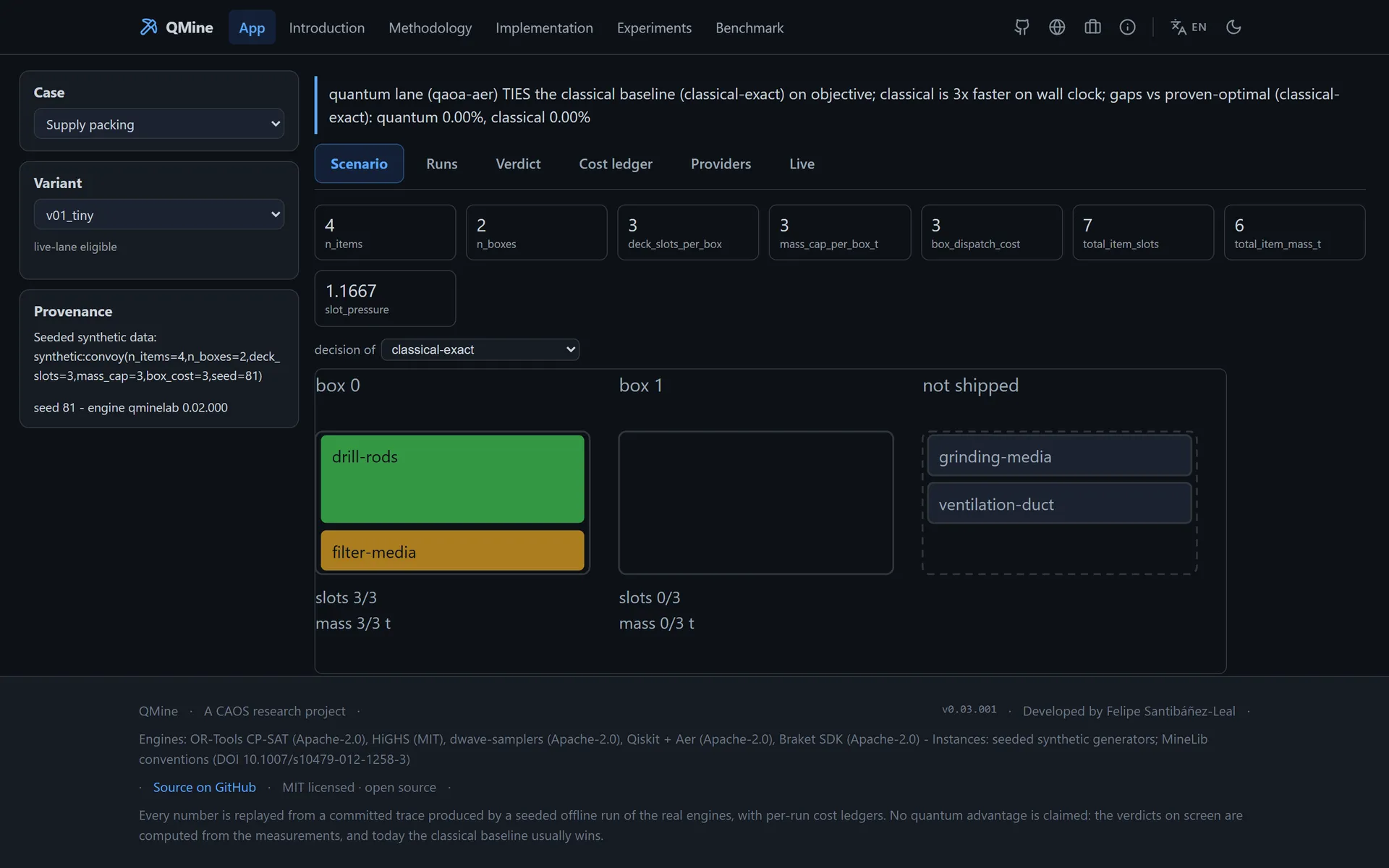
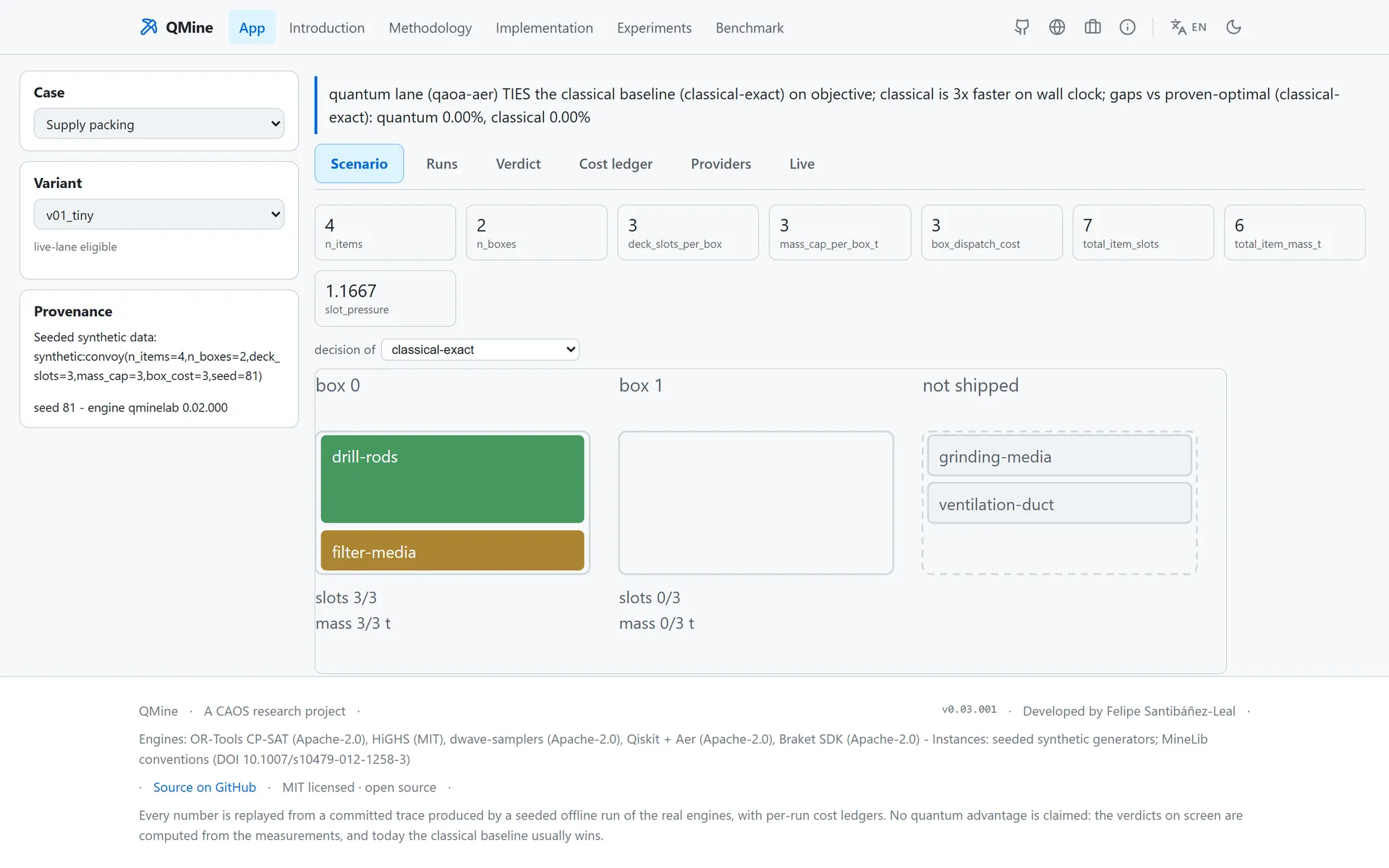
The value is measurement discipline where advocacy is the norm: a plant lead can see, per case, which lane reached the proven optimum, how far the others were, what each run cost in money and how long it took. The early measured results are stated as measured: on tiny pit instances the problem-aware gate variants (warm-start, CVaR, DCQO, BF-DCQO) reach the proven optimum where plain QAOA and the problem-agnostic VQE do not; on the supply-packing case the quantum lane ties the classical baseline on objective while the classical solver is three times faster; on the flotation soft sensor ridge regression beats both quantum models and the quantum kernel is worse than the persistence floor. Two formulations have no located prior art (truck dispatch, flotation circuit design); crew rostering was miscounted as a third and its production prior art is recorded on its own case page.
Strategic Value
QMine is the research line's answer to a question its owner is asked in industry, built from four primary-source dossiers and kept private because the backend holds provider credentials, an async job store and a heavy engine stack (OR-Tools, Qiskit, Torch, Braket, Ocean). It is deployed as a service on the ML VPS behind an operator session with an idempotent installer that refuses a foreign process on its port and a bundle carrying data, and both browser gates were re-run against the deployment rather than a local build. No quantum advantage is claimed anywhere; the verdicts on screen are computed from the measurements. The 0.03.001 release of the fleet pass corrected a tag that had been placed on sources still reading the previous version, and an operator database that had been a tracked file mutated by the service is now ignored. Lifecycle building, no adopter yet.
The Challenge
The claims around quantum computing for industrial optimization are loud and the measurements are scarce. A mining company asked whether an annealer or a gate-model device could schedule its trucks, design a flotation circuit or cut a pit has no independent number to look at, only vendor material. Answering honestly requires running every real engine on the same instances with the same evaluation, denominating every run in money, recording every skip with its reason, and letting a verdict be computed from the measurements rather than written by an advocate. The public didactic lab of canonical quantum problems (QLab) exists; this is its industrial counterpart, private and provider-integrated, with real datasets.
Our Approach
A Problem by Solver by Instance abstraction: a Problem owns its dataset-backed instances, its audited QUBO encoding, its native constrained model (hard constraints, no penalties), its domain evaluation, its exact and heuristic baselines and its visualization payload; a Solver is a thin adapter over one real engine; modules are auto-discovered, so a new case or engine is one file. The methods are all real engines: OR-Tools CP-SAT, HiGHS, networkx max-closure and a treewidth-bounded exact decomposition; field heuristics and a random floor; dwave-samplers simulated annealing, tabu, steepest descent, path-integral quantum annealing and rotor-model annealing; dwave-hybrid parallel tempering and decomposition without a QPU; Torch simulated bifurcation (ballistic and discrete); QAOA with warm-start, CVaR, recursive, DCQO and BF-DCQO variants, a hardware-efficient VQE and an independent PennyLane implementation; a quantum kernel and a variational regressor for the flotation soft sensor with leakage-safe temporal splits. Eleven provider lanes are wired and credential-gated, each recording an explicit skip when no credential exists. The canonical bake covers 121 of 121 variants with 1,631 explicit skips and zero completeness problems; 160 tests, four content guards. Every number on the site replays a committed trace from a seeded offline run of the real engines, with per-run cost ledgers; the app runs behind an operator session on the ML VPS.
Key Performance Indicators
| KPI | Baseline | Result | Impact |
|---|---|---|---|
| Measurement, not advocacy | Vendor material and no independent number | Every instance runs the whole ladder on real engines with a money-denominated cost ledger and a computed verdict; 121 of 121 variants baked, 1,631 skips explicit | The verdict is computed, and today the classical baseline usually wins |
| Where the quantum lanes do and do not reach | A generic claim of advantage | Problem-aware gate variants reach the proven optimum on tiny pit instances where plain QAOA and VQE do not; a tie on supply packing with the classical solver 3x faster; ridge beats both quantum models on the soft sensor | Each case page says which lane earned its keep |
| Prior art, counted honestly | Three novel formulations claimed | Two with no located prior art (truck dispatch, flotation circuit design); crew rostering recounted, with its production prior art on its case page | The novelty claim shrank to what the searches support |
Proprietary, source code not publicly available
Architecture
qmine pipeline
Technology Stack
Application Screenshots