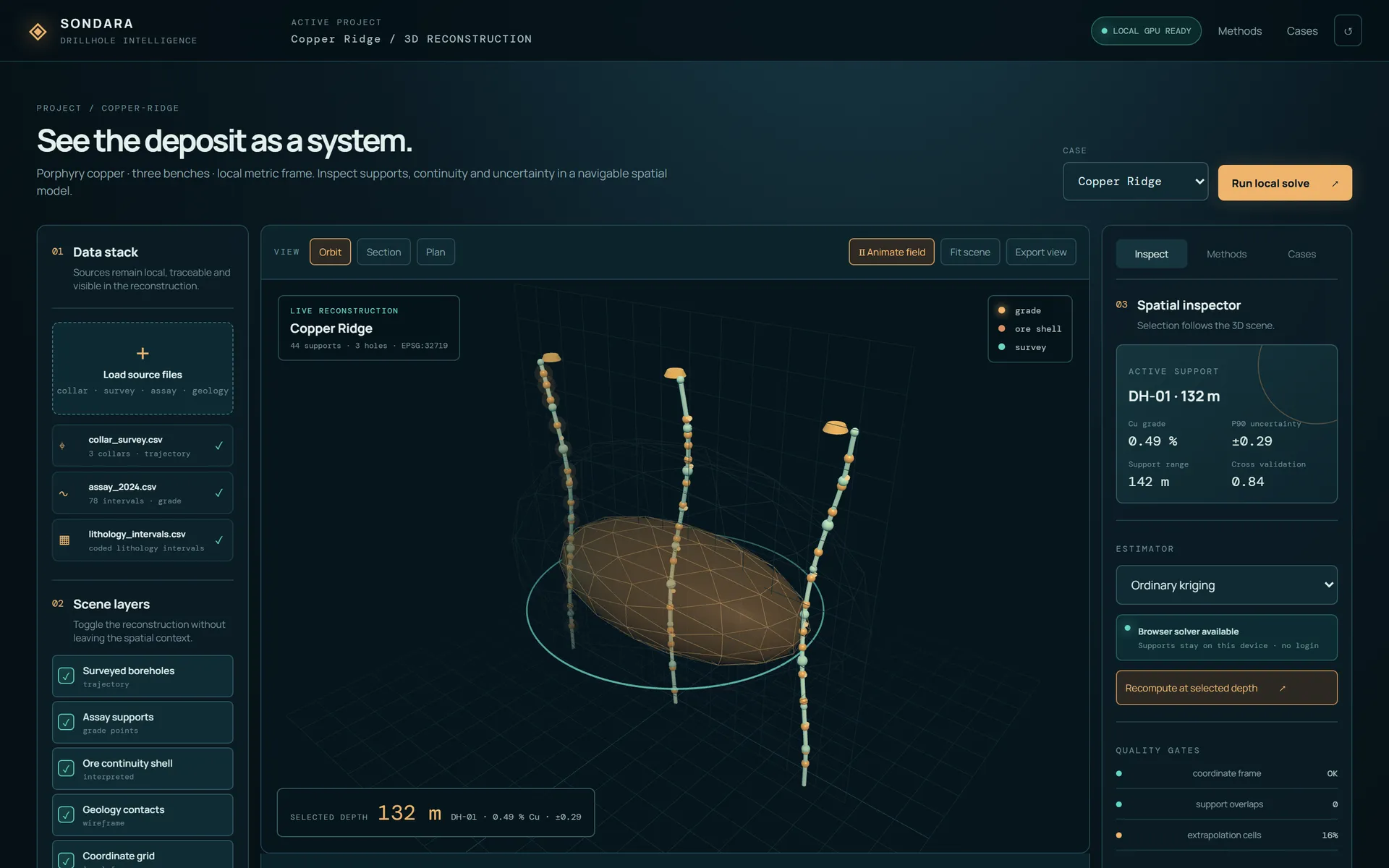
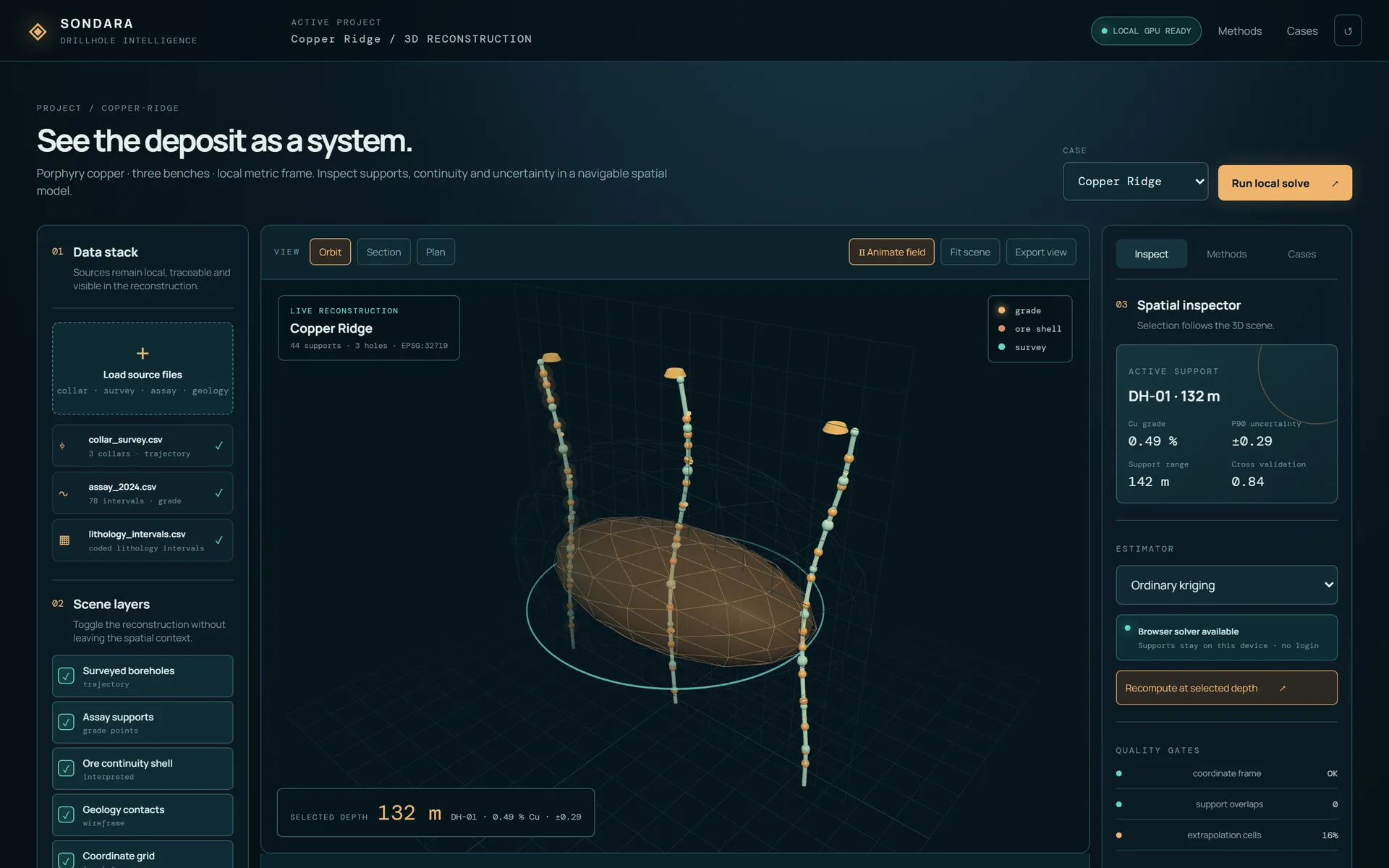
Sondara, Drillhole Estimation and Simulation Compared on Real Held-Out Holes
Three public drillhole families run through one reproducible pipeline, and twelve estimation and simulation methods, from nearest neighbour and kriging to SNESIM, Direct Sampling, DeepKriging and KCN, predict the same held-out holes under one scoring. On Rocklea iron ordinary kriging holds its place; the learned methods learn the structure without beating it.
Business Context
For a project geologist or a resource team the value is a comparison they can reproduce: which estimator to trust on these holes, how much a learned model really adds, and where the data itself is weaker than it looks (a spectral column named as a ratio that is a wavelength, twelve holes whose spectral depths are offset from the assays). It is evidence for choosing a method, not a resource estimate.
Strategic Value
Sondara is in construction with its plan as the implementation authority: eight of ten pipeline stages are built and every scenario cell is accounted for (61 computed, 20 verified by tests, 4 pending for export and validate). The live page still shows the 0.2 local-first viewer; the web product rebuilt on these results comes after export and validate. Sibling of Aerovia by rebuild discipline.
The Challenge
Drillhole estimates are usually judged by the method that produced them. The honest question is different: which method predicts a hole that was never drilled into the model, on real data, and is the difference larger than the noise between holes? Answering it needs real sources pinned by hash, splits by whole hole, the same targets for every method and a scoring that also says when a model learned nothing.
Our Approach
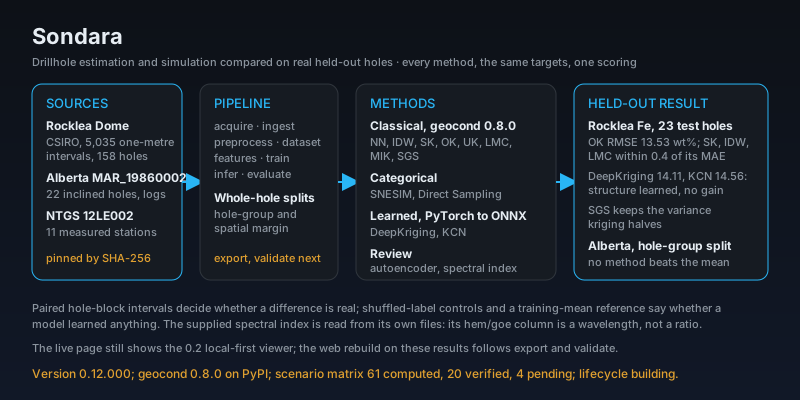
An offline pipeline of eight built stages (acquire, ingest, preprocess, dataset, features, train, infer, evaluate) over Rocklea Dome (CSIRO, 5,035 one-metre multielement intervals in 158 holes), Alberta MAR_19860002 (22 inclined holes with logged geology) and NTGS 12LE002 (one hole with eleven measured survey stations). The classical methods and Direct Sampling run on geocond, the engine published on PyPI; SNESIM runs through MPSlib at a pinned commit; DeepKriging and KCN train on the GPU and ship as audited ONNX models with CPU, CUDA and ONNX parity. Every method predicts the same held-out holes, and paired hole-block intervals decide whether a difference is real.
Key Performance Indicators
| KPI | Baseline | Result | Impact |
|---|---|---|---|
| Every method, the same held-out holes | Each method judged on its own cross-validation | Twelve methods predict the same targets on whole-hole splits; paired hole-block bootstrap intervals against ordinary kriging | A difference smaller than the noise between holes is reported as none |
| A learned model has to beat its own control | A neural network compared only with kriging | Shuffled-label controls and a training-mean reference: on Rocklea both learned methods beat their controls by 2.3 to 5.4 wt% of MAE without beating OK; on Alberta's hole-group split no method beats the training mean | Whether a model learned anything is measured, not assumed |
| Not a resource estimate, in writing | A comparison read as a certified estimate | Predictions at support centres, not block grades; simulations conditional on labelled interpretations; three Alberta test holes called weak evidence | The scope stays honest while the product grows |
Architecture
sondara pipeline
Technology Stack
Application Screenshots