CutoffGrade Studio, Lane's Optimal Cut-off Grade
An open, explainable studio for Lane's optimal cut-off grade: feed a grade-tonnage curve plus prices, costs and three stage capacities, and it computes the NPV-maximising declining cut-off trajectory, NPV, mine life and cashflow, live in the browser, with the exact algorithm as the authority and a learned surrogate only for speed.
Business Context
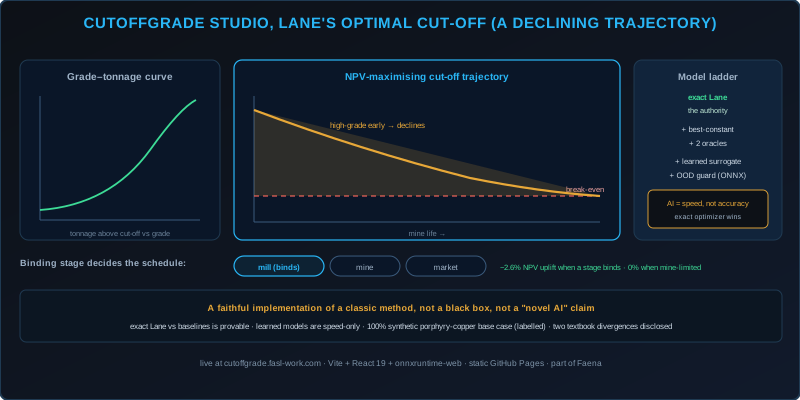
Cut-off strategy directly moves the NPV of an operation, and the counter-intuitive part (that you should mine at a higher cut-off early and let it decline, and that the binding stage decides the whole schedule) is exactly where value is left on the table. A studio that makes the trajectory and its binding constraint visible, and lets you sweep prices, costs and capacities and watch the NPV respond, turns Lane's theory from a formula into an intuition you can build and check.
Strategic Value
CutoffGrade Studio is a faithful, auditable implementation of a classic optimization method, not a black box and not a "novel AI" claim. It shows the exact Lane optimizer against a best-constant baseline and closed-form oracles, so the ~2.6% NPV uplift it finds (when a processing stage binds; zero when the mine is the limit, exactly as theory predicts) is a provable result rather than an assertion. The learned layer is labelled speed-only, the base case is openly synthetic, and the repo even discloses two small divergences from textbook Lane, the kind of transparency that makes an economics tool trustworthy.
The Challenge
The cut-off grade, the line between ore and waste, is one of the highest-leverage decisions in a mine plan, and Lane's theory says the NPV-maximising cut-off is not a single number but a trajectory that declines over the mine's life and is set by whichever stage (mine, mill or market) is the binding constraint. That result is subtle, easy to get wrong, and usually locked inside a spreadsheet or a proprietary planning tool with no way to see why the answer is what it is.
Our Approach
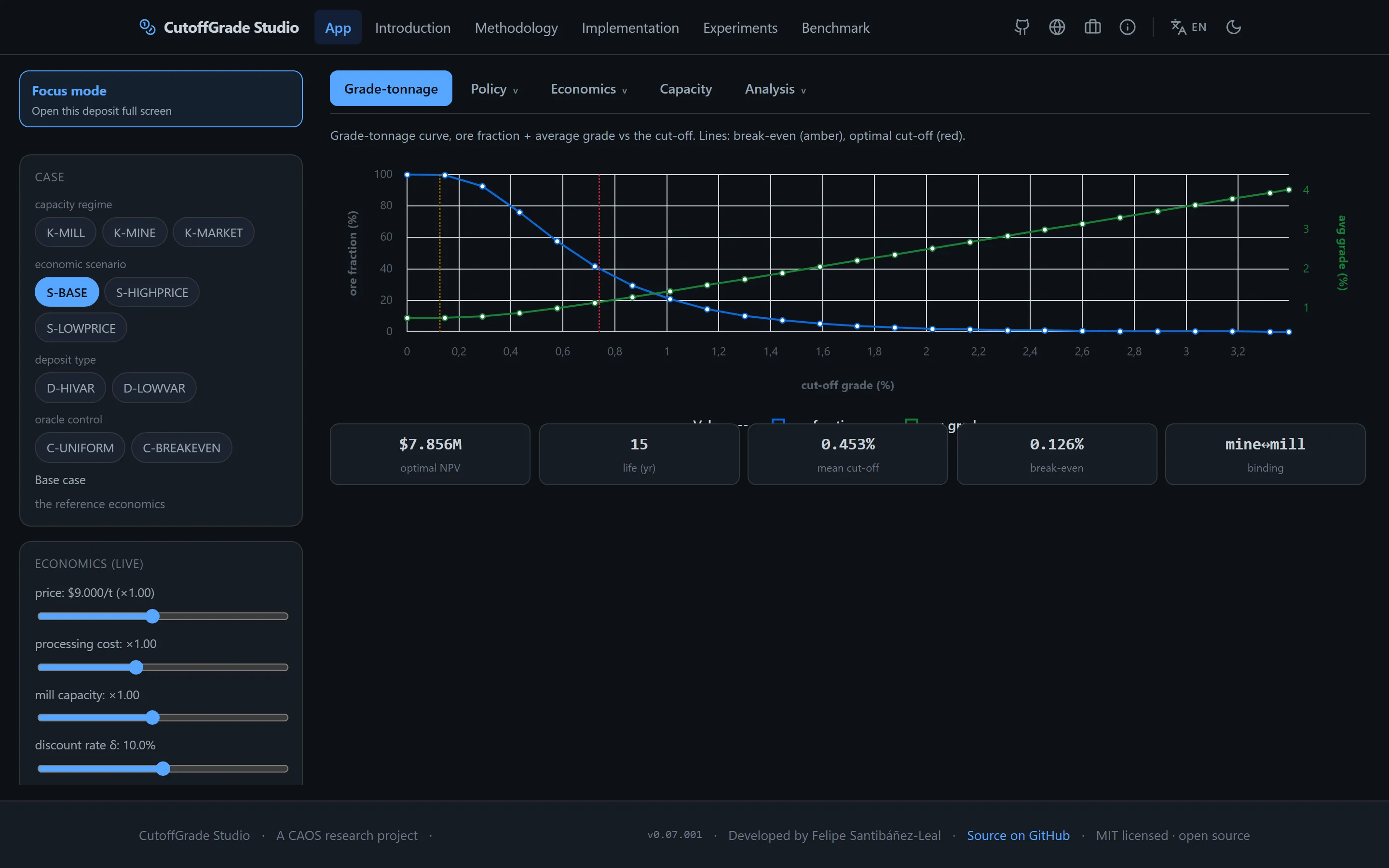
CutoffGrade Studio implements Lane's method exactly and transparently: from a grade-tonnage curve and the economic and capacity inputs it computes the six characteristic cut-offs and the balancing (Dagdelen) medians, then runs a year-by-year NPV simulator to a fixed point to find the declining optimal trajectory, NPV, mine life and cashflow. The exact optimizer is the authority; on top, two small models trained offline (PyTorch → ONNX) run live via onnxruntime-web (a surrogate that reproduces the trajectory instantly for slider sweeps, and an out-of-distribution guard) but they are for speed and sanity, never to improve the answer. A ten-tab workbench reacts to a case selector and live sliders, with the governing equations on screen.
Key Performance Indicators
| KPI | Baseline | Result | Impact |
|---|---|---|---|
| Cut-off as a trajectory | A single break-even cut-off | The NPV-maximising declining trajectory + its binding stage | See where value is left on the table |
| Provable, not asserted | Spreadsheet / black box | Exact Lane vs best-constant + oracles; ~2.6% NPV uplift when a stage binds | The result is auditable end to end |
| The AI's role | "AI improves the plan" | Learned surrogate = instant sweeps; exact optimizer is the authority | The model is for speed, not accuracy |
Architecture
cutoffgrade studio
The cut-off is a trajectory, not a number
CutoffGrade Studio computes Lane’s optimal cut-off grade, the NPV-maximising cut-off that declines over a mine’s life and is set by whichever stage (mine, mill or market) is the binding constraint. Feed a grade-tonnage curve plus prices, costs and three stage capacities, and it returns the trajectory, NPV, mine life and cashflow, live in the browser. Live at cutoffgrade.fasl-work.com, part of the Faena mining-analytics hub.
Exact method as the authority
The engine implements Lane’s method exactly, the six characteristic cut-offs, the balancing (Dagdelen) medians, and a year-by-year NPV simulator run to a fixed point, and shows it against a best-constant baseline and closed-form oracles, so the ~2.6% NPV uplift it finds when a processing stage binds (and 0% when the mine is the limit, exactly as theory predicts) is provable, not asserted. The governing equations are on screen; the App is a real ten-tab workbench that reacts to a case selector and live sliders.
The AI layer and the data
Two small models run live via onnxruntime-web, a surrogate that reproduces the trajectory instantly for slider sweeps and an out-of-distribution guard, but they are for speed and sanity, not to improve the answer (the exact optimizer is always the authority). The base case is 100% synthetic (a porphyry-copper example, openly labelled), and the repo discloses its two small divergences from textbook Lane. No real mine data, no “novel-beyond-SOTA” claim, a faithful classic method, made legible.
Technology Stack
In action
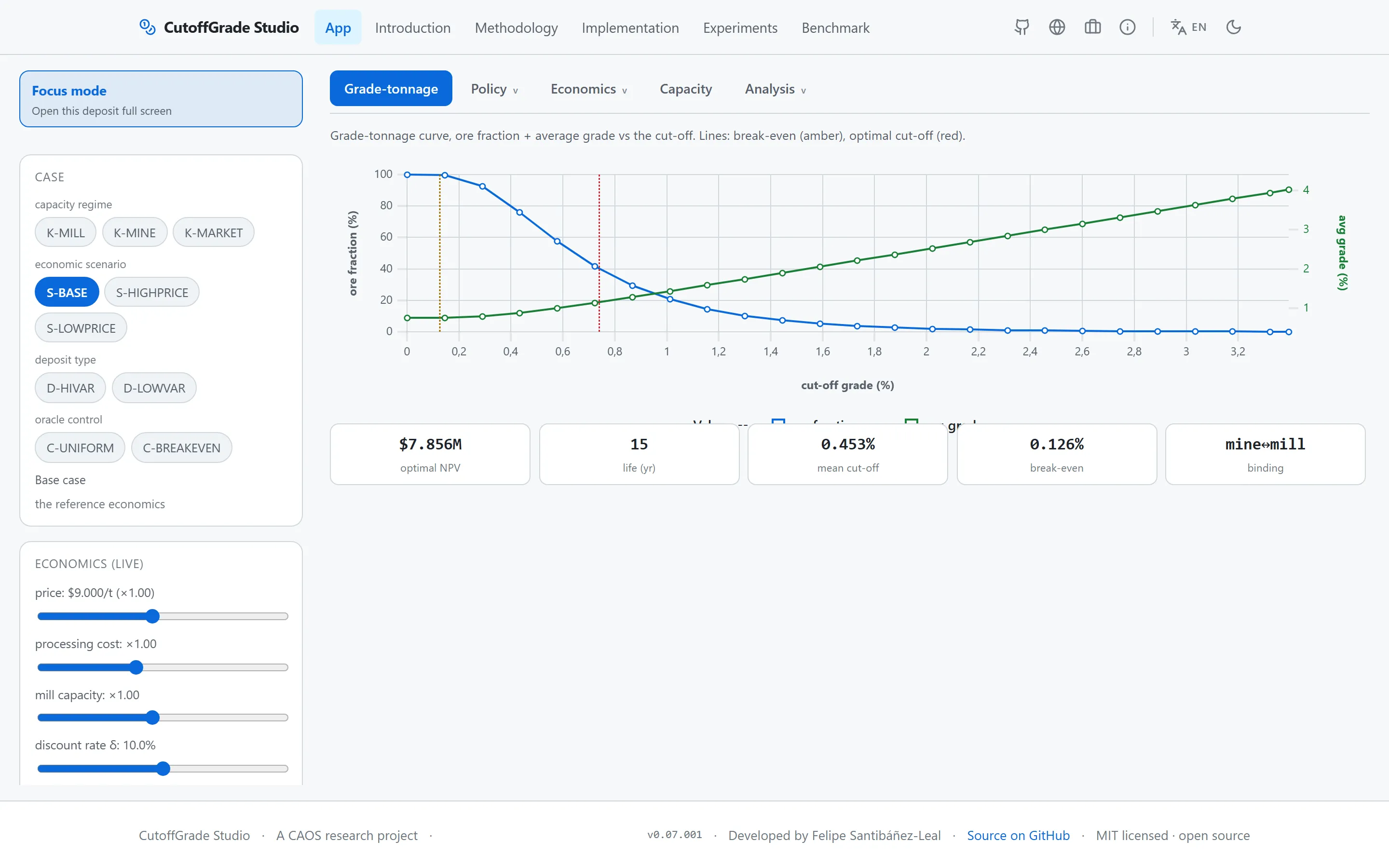
A short tour of the live app: the real interface, recorded from the deployed site.

Application Screenshots