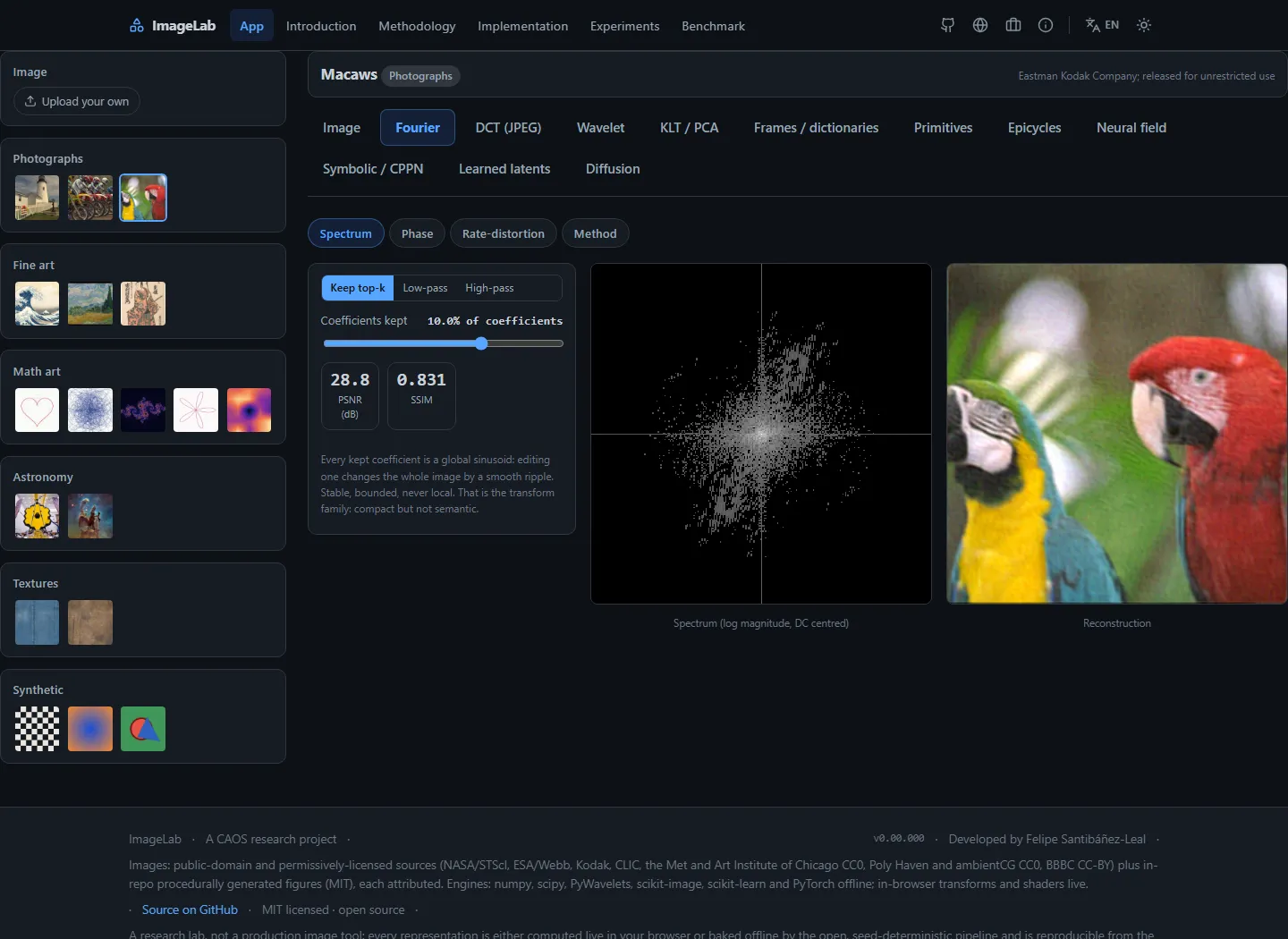
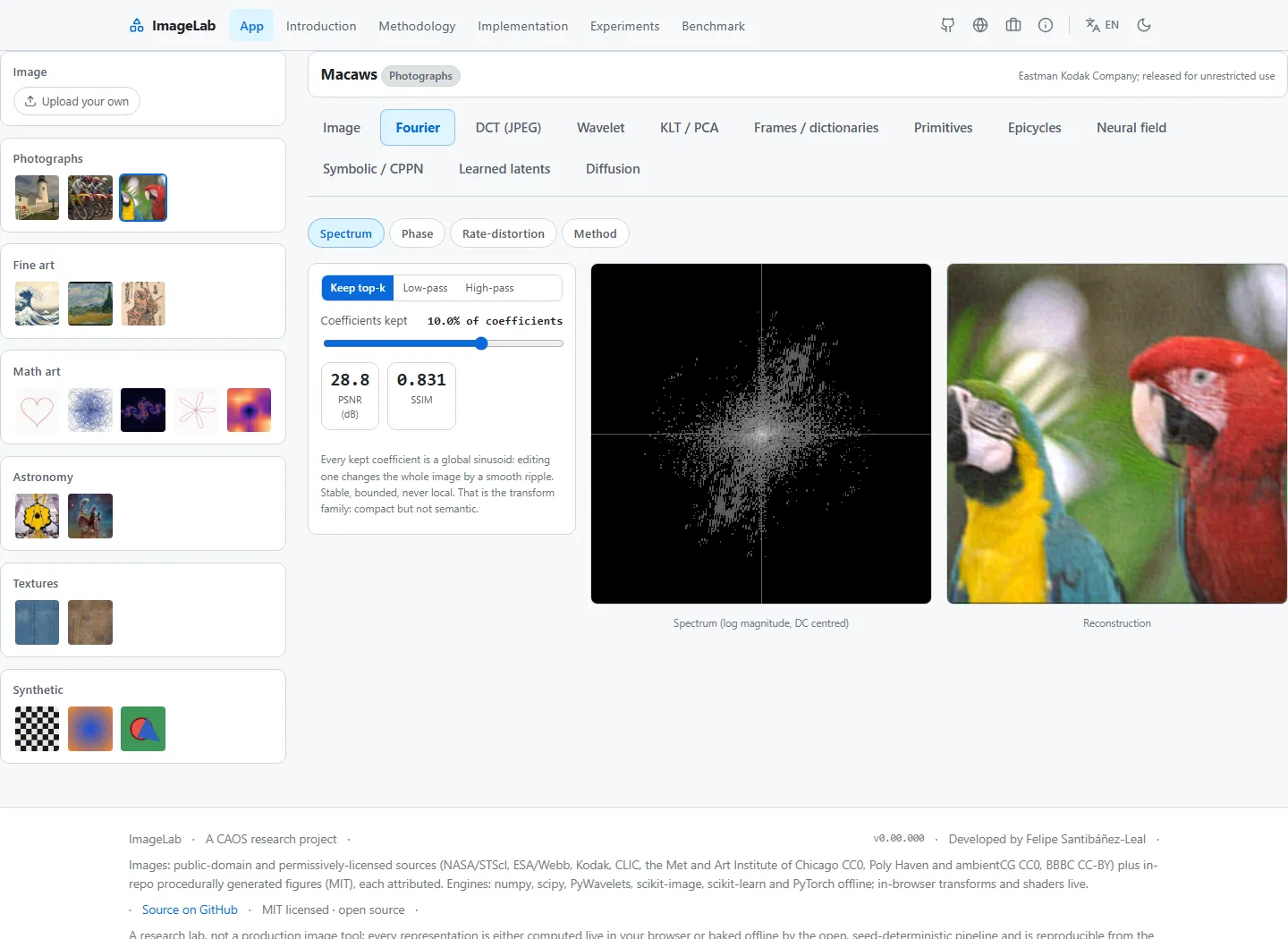
ImageLab, One Image Across the Full Spectrum of Mathematical Representations
One image written across eleven mathematical representations: orthonormal transforms (Fourier, DCT, wavelet, KLT), overcomplete sparse dictionaries, geometric primitives, an implicit neural field (SIREN), symbolic CPPN formula art, Fourier-descriptor epicycles, and learned generative latents (VAE, diffusion), each with editable parameters. The measured thesis is that editability is U-shaped: it peaks at the designed-structure pole (local, exact edits) and the learned-manifold pole (semantic, entangled edits) and collapses to noise between. Everything is computed live in the browser (TypeScript, WebGL2) or baked offline by an open, seed-deterministic Python pipeline.
Business Context
Representation choice is the quiet decision under most image work: compression, denoising, inpainting, editing, and generative modeling each pick a basis and live with its trade-offs. ImageLab is that decision made visible and measurable: a teaching and reference instrument that shows, on one image and with one yardstick, what each family is good at and where it breaks, rather than a single flattering result per transform.
Strategic Value
ImageLab covers the full designed-to-learned spectrum on one image, from exact orthonormal transforms to a diffusion latent, and reports a real measured benchmark rather than an asserted intuition: the U-shaped editability curve is shown with numbers, and the fidelity metrics are identical across the Python pipeline and the TypeScript runtime. It states its scope: it is a CAOS research and teaching lab, not a production codec, not a state-of-the-art generative model, and not a claim that any one representation is best; it uses a small reference image and reports every number as-is. The value is a credible, reproducible map of when a parameter edit stays meaningful and when it becomes noise.
The Challenge
An image can be written in many mathematical languages, but the usual demos show each one in isolation and never ask the question that decides whether a representation is useful for editing or compression: when you perturb its parameters, does the change stay meaningful, or does it collapse into noise? A Fourier coefficient, a wavelet detail, a KLT component, a dictionary atom, a neural-field weight, and a diffusion latent all edit the image, but they do not edit it the same way, and almost nothing puts them side by side on the same picture with the same measured yardstick.
Our Approach
ImageLab writes one reference image in eleven representations and lets you edit each one's parameters directly: the orthonormal transforms Fourier, DCT, wavelet, and KLT, overcomplete sparse dictionaries, geometric primitives, an implicit neural field (SIREN), symbolic CPPN formula art, Fourier-descriptor epicycles, and learned generative latents from a VAE and a diffusion model. It is built as two worlds joined by a metric contract: light representations are computed live in the browser with TypeScript and WebGL2 shaders, heavy ones are baked offline by an open, seed-deterministic Python pipeline (numpy, scipy, PyWavelets, scikit-image, scikit-learn, PyTorch, diffusers), and the fidelity metrics (PSNR, SSIM, MS-SSIM) are shared between the two so the number you read in the browser equals the number the pipeline computed. The Experiments and Benchmark pages carry the measured cross-family comparison: a rate-distortion sweep, a fixed-budget fidelity table, and an editability-locality metric that scores how local an edit stays (KLT and wavelet near 1.0, local and exact; Fourier and DCT around 0.16 to 0.23, global and entangled).
Key Performance Indicators
| KPI | Baseline | Result | Impact |
|---|---|---|---|
| Representations catalogued and shipped | Fourier first (single transform) | 11 across the full designed-to-learned spectrum | One image written as transforms, dictionaries, primitives, neural fields, and generative latents |
| Cross-family benchmark | Single-transform demos, no shared yardstick | Measured rate-distortion + fixed-budget fidelity + editability-locality | The U-shaped editability thesis shown with real numbers |
| Editability-locality metric | Asserted intuition (local vs global edits) | KLT / wavelet ~1.0 (local-exact) vs Fourier / DCT ~0.16–0.23 (global-entangled) | Quantifies when a parameter edit stays local and when it spills across the image |
| Cross-language metric parity | Separate offline and in-browser numbers | Shared PSNR / SSIM / MS-SSIM between Python and TypeScript | The fidelity you read in the browser equals the offline pipeline number |
One image, eleven representations
ImageLab writes a single reference image in eleven mathematical representations and lets you edit each one”s parameters directly: the orthonormal transforms Fourier, DCT, wavelet, and KLT; overcomplete sparse dictionaries; geometric primitives; an implicit neural field (SIREN); symbolic CPPN formula art; Fourier-descriptor epicycles; and learned generative latents from a VAE and a diffusion model. Light representations run live in the browser (TypeScript and WebGL2 shaders); heavy ones are baked offline by an open, seed-deterministic Python pipeline. Live at imglab.fasl-work.com.
The U-shaped editability thesis
The organizing question is what happens when you perturb a representation”s parameters. The measured answer, shown on the Experiments and Benchmark pages, is that editability is U-shaped: it peaks at the designed-structure pole, where edits are local and exact (KLT and wavelet score near 1.0 on the editability-locality metric), and at the learned-manifold pole, where edits are semantic and entangled, and it collapses toward noise in between (Fourier and DCT sit around 0.16 to 0.23, global and entangled). The cross-family benchmark makes this concrete with a rate-distortion sweep and a fixed-budget fidelity table, and the fidelity metrics (PSNR, SSIM, MS-SSIM) are shared between the Python pipeline and the TypeScript runtime, so the number you read in the browser is the number the pipeline computed.
Scope
ImageLab is a CAOS research and teaching lab, a sibling of PINN-Lab, QLab, SimLab, and ChronoScope. It is not a production codec, not a state-of-the-art generative model, and not a claim that any single representation wins: it works on a small reference image, reports every number as-is, and is bilingual (EN/ES) with light and dark themes. The value is the reproducible map of when a parameter edit stays meaningful and when it becomes noise.
Technology Stack
Application Screenshots