PINN-Lab, A Runnable Catalogue of Physics-Informed Neural Networks
A live catalogue of 19 Physics-Informed Neural Network cases: each trained offline (DeepXDE → ONNX), validated against an analytic, benchmark, or real-data anchor, and re-inferred live in the browser: move a physical parameter and watch the trained network re-solve the PDE.
Business Context
Scientific machine learning is moving from papers into engineering practice, but adoption needs a map: which problem shapes (forward, inverse, parametric, operator) PINNs handle well, how they compare to a trusted classical anchor, and where their known failure modes (spectral bias, stiff regimes) bite. PINN-Lab is that map made runnable, a teaching and decision instrument rather than a single cherry-picked result.
Strategic Value
PINN-Lab demonstrates the full scientific-ML method ladder (forward, inverse, UQ, operator learning) shipped as a reproducible, browser-runnable catalogue with measured benchmarks (ONNX parity < 1e-4 everywhere; relative-L2 published per case, including the deliberately-imperfect ones). It is built on a clean two-world architecture (offline train/export, online inference) and states its scope: it is not an FEM replacement, most cases are synthetic by design at 0.x, and accuracy is reported as-is. The value is a credible reference for when PINNs are the right tool and when a classical solver wins.
The Challenge
Physics-Informed Neural Networks are widely hyped and rarely shown with their failures: most demos are a single forward problem on a clean equation, with no anchor to say whether the answer is right, no inverse or uncertainty problems, and nothing you can actually run. The interesting questions (where do PINNs help, where do they struggle, and how close are they to a trusted reference) go unanswered.
Our Approach
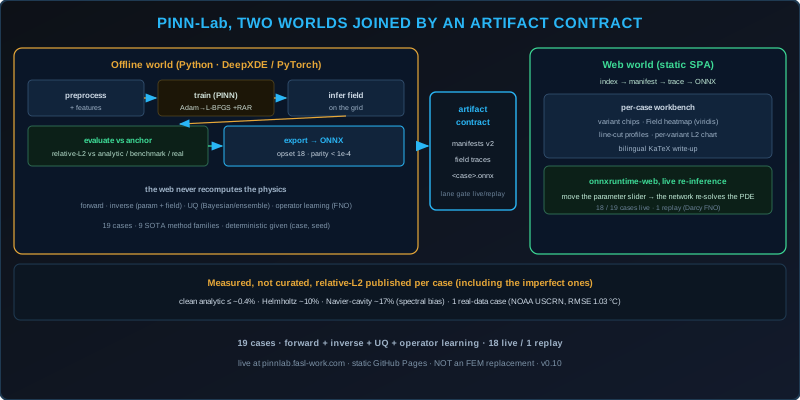
PINN-Lab is a method catalogue and per-case workbench of 19 cases, built as two worlds joined by an artifact contract: a heavy offline Python pipeline (preprocess → train with DeepXDE/PyTorch → validate against an analytic / benchmark / real-data anchor → export to ONNX, opset 18, with parity < 1e-4) and a light static web app that never recomputes the physics. 18 of the 19 cases ship their ONNX and re-evaluate live in the browser via onnxruntime-web, because the physical knob is a network input, one trained net drives a whole parameter family with a continuous live sweep. It exercises the real method ladder: forward PDE solving, inverse problems (parameter and field recovery), uncertainty quantification (Bayesian / ensemble), and operator learning (FNO). A measured lane gate classifies each case live vs precompute from real numbers (ONNX size, inference time, trace size).
Key Performance Indicators
| KPI | Baseline | Result | Impact |
|---|---|---|---|
| Cases catalogued and shipped | 1 anchor case (v0.02) | 19 cases across 5 categories (v0.10) | Full SOTA method ladder exercised end to end |
| Cases running live in-browser | 0 (replay-only concept) | 18 / 19 live ONNX inference (1 replay) | Move a parameter, the network re-solves client-side |
| Real-data validation | All synthetic | 1 case on real NOAA USCRN soil temps (held-out RMSE 1.03 °C) | Inverse parameter recovery on genuine data, labeled as such |
Architecture
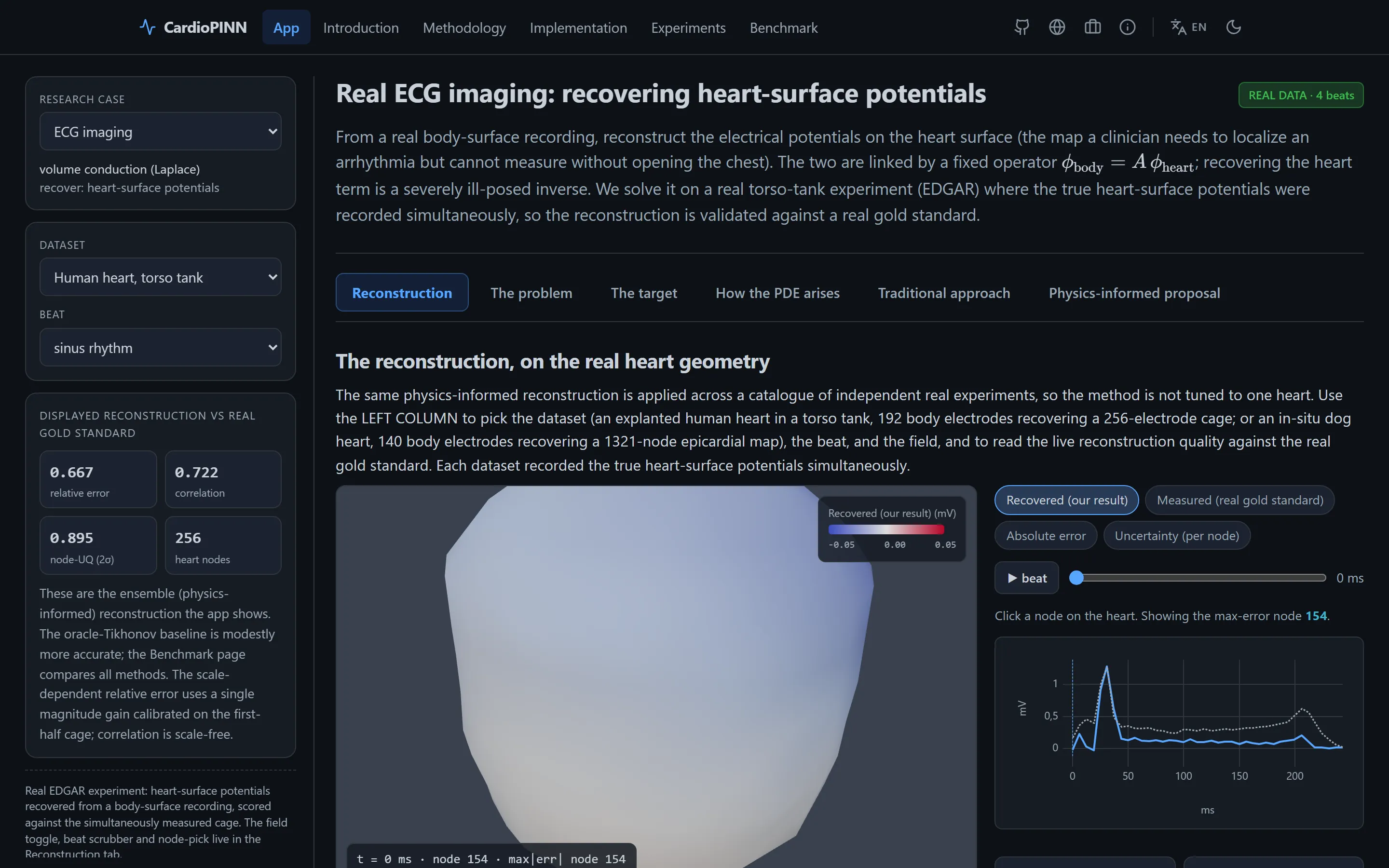
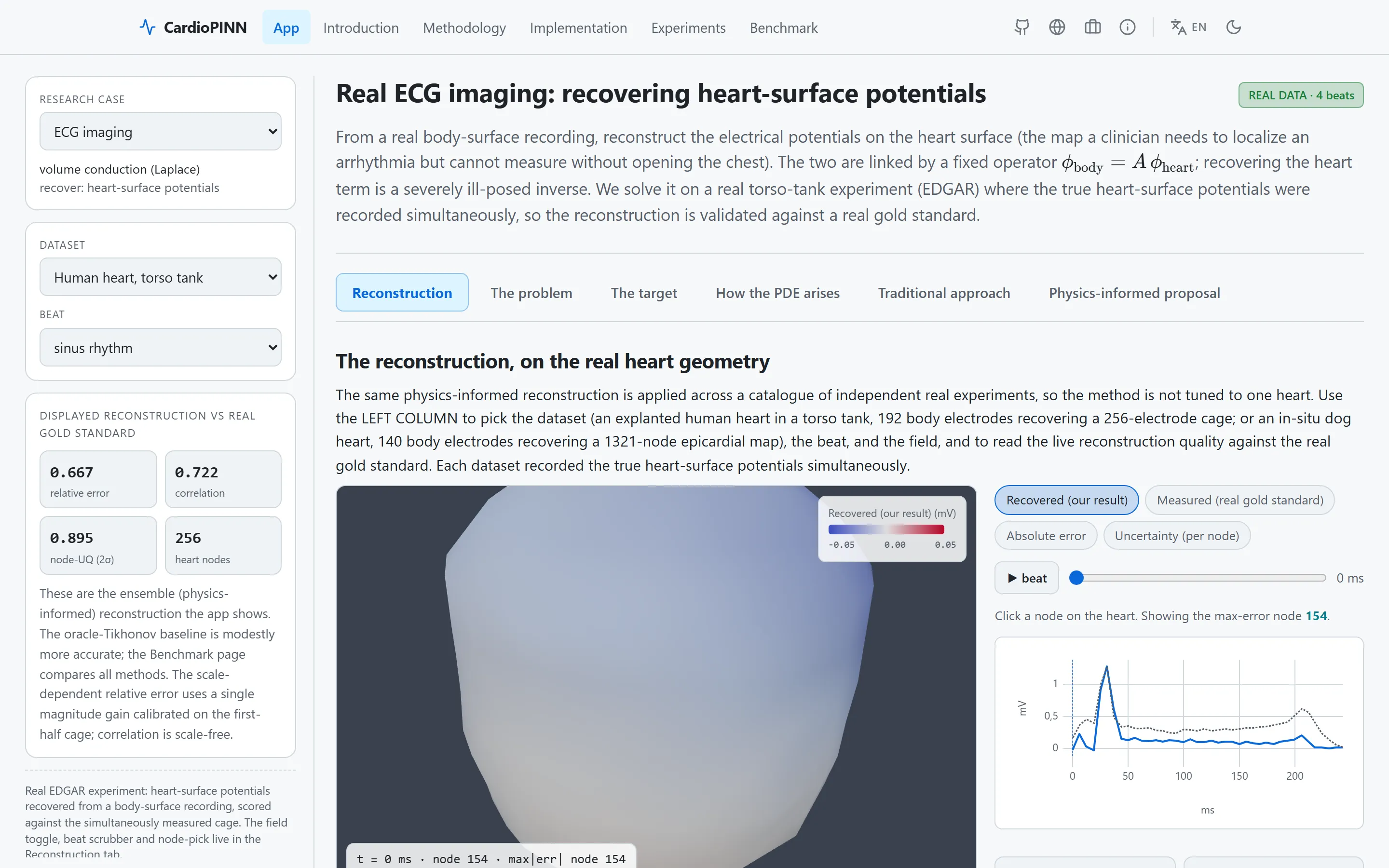
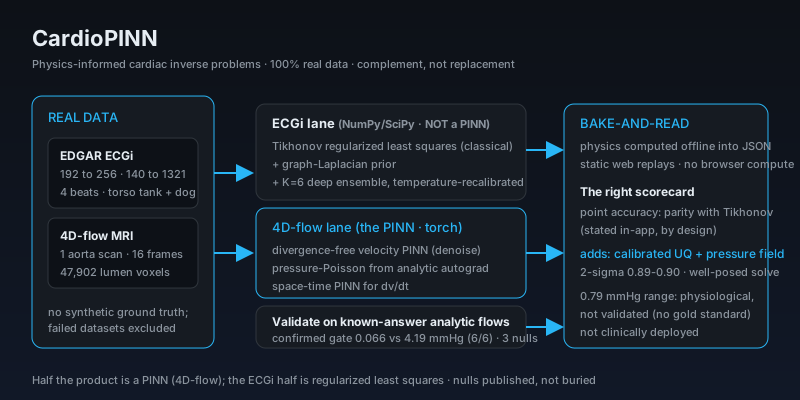
cardiopinn pipeline
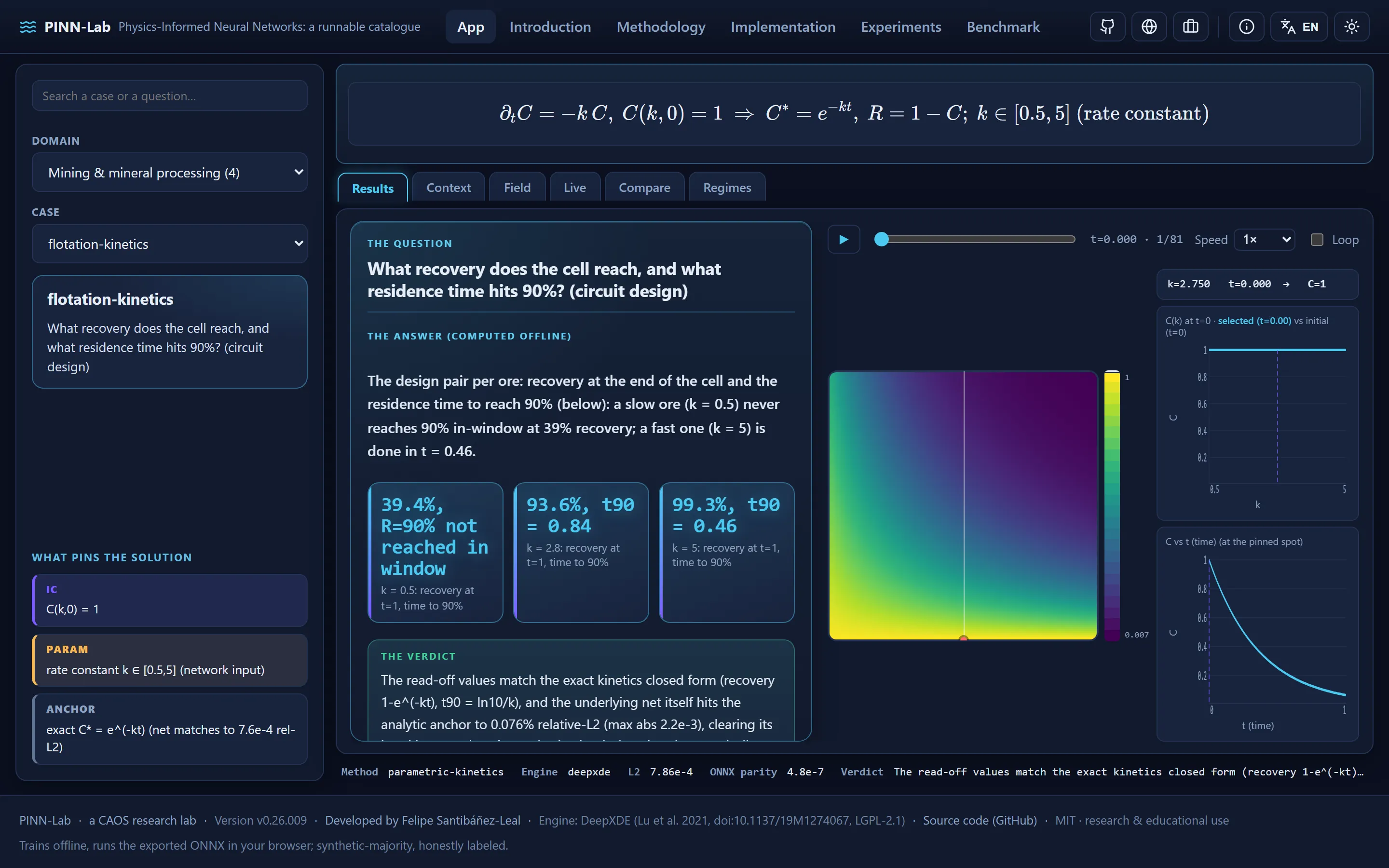
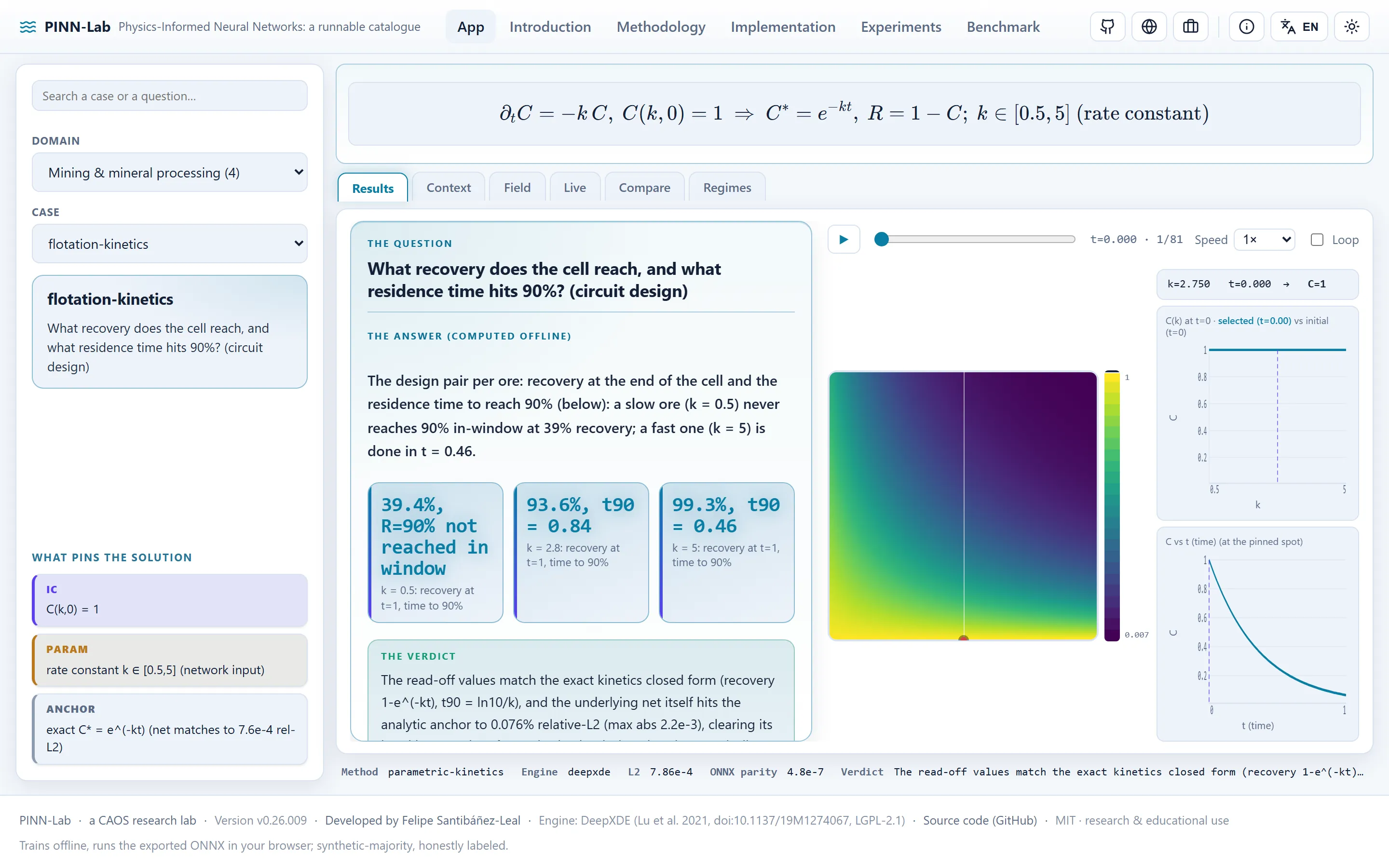
pinnlab architecture
Train offline, re-solve live
PINN-Lab is a runnable catalogue of 19 Physics-Informed Neural Network cases. Each is trained offline with DeepXDE/PyTorch, validated against an analytic, benchmark, or real-data anchor, and exported to ONNX, then the static web app loads that ONNX and re-infers it live in the browser (onnxruntime-web). Because the physical parameter is a network input, you move a slider and the trained network re-solves the PDE client-side, in real time. Live at pinnlab.fasl-work.com.
The full method ladder
It is not one forward problem: it exercises the real range of scientific ML: forward PDE solving, inverse problems (parameter and field recovery), uncertainty quantification (Bayesian / ensemble), and operator learning (a Fourier Neural Operator generalizing across coefficient fields). Nine SOTA method families appear (hard constraints, adaptive sampling, Fourier features, SIREN, loss weighting, domain decomposition, FNO, inverse recovery, ensemble UQ), each in a per-case workbench with an interactive field heatmap, a live slider, a per-variant error chart, and a bilingual write-up with the governing equations in KaTeX.
Accuracy and scope
Benchmarks are measured, not curated: ONNX parity is < 1e-4 everywhere, and relative-L2 is published per case, including the cases that sit at known PINN limits (Helmholtz ~10%, Navier-cavity ~17%, a soil-barrier case ~19% from spectral bias and the CPU training lane). PINN-Lab is not an FEM/FVM replacement (a good classical solver beats a PINN on a single well-posed forward problem), not an industrial digital twin, and not trained on real industrial data, only one of the 19 cases (soil heat, NOAA USCRN) uses real measurements; the rest are analytic anchors or synthetic-illustrative reduced models, all labeled as such. It is deliberately a 0.x release while predominantly synthetic.
Technology Stack
Reel
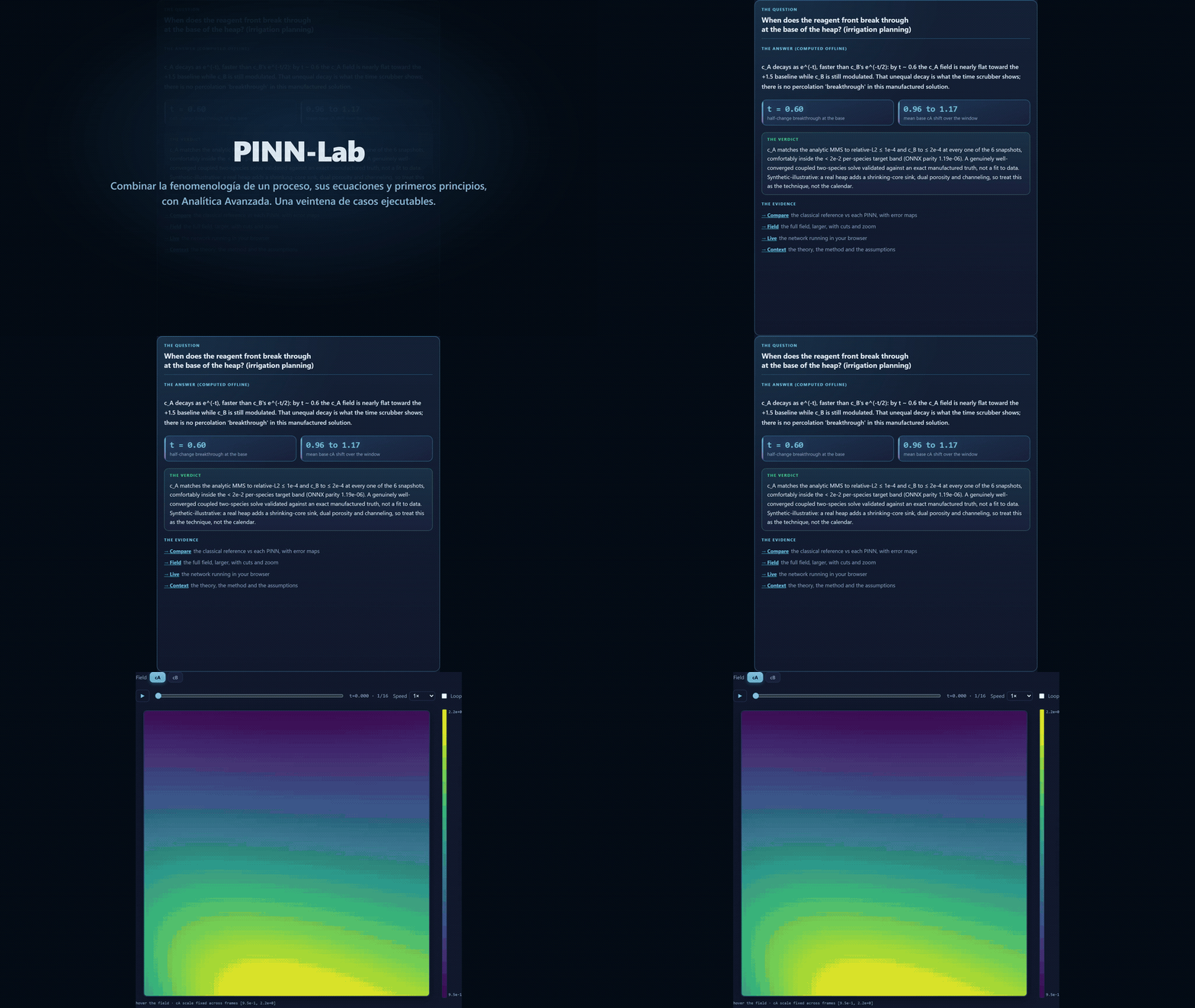
A short, composed reel of the product.
In action
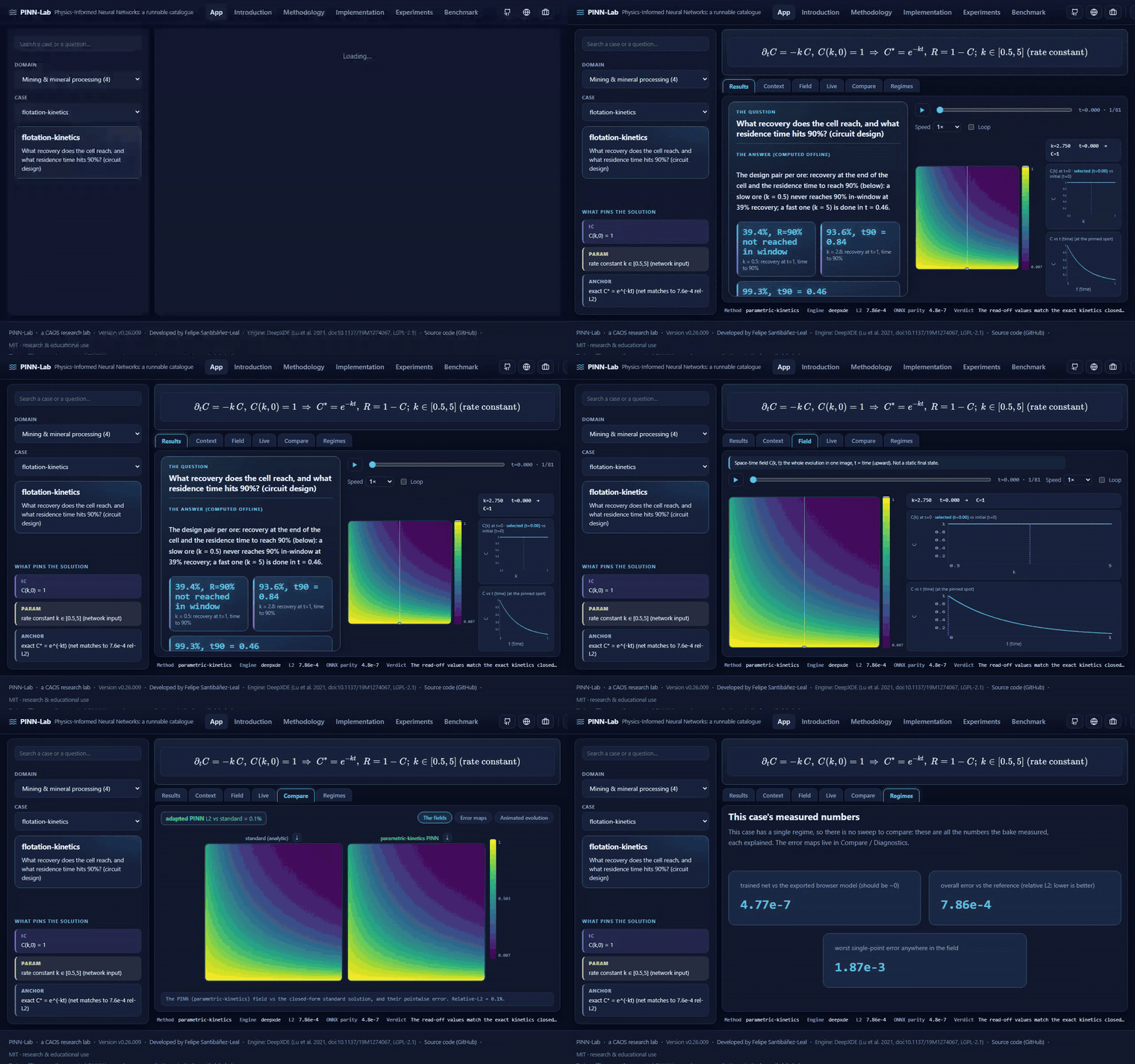
A short tour of the live app: the real interface, recorded from the deployed site.
Application Screenshots